


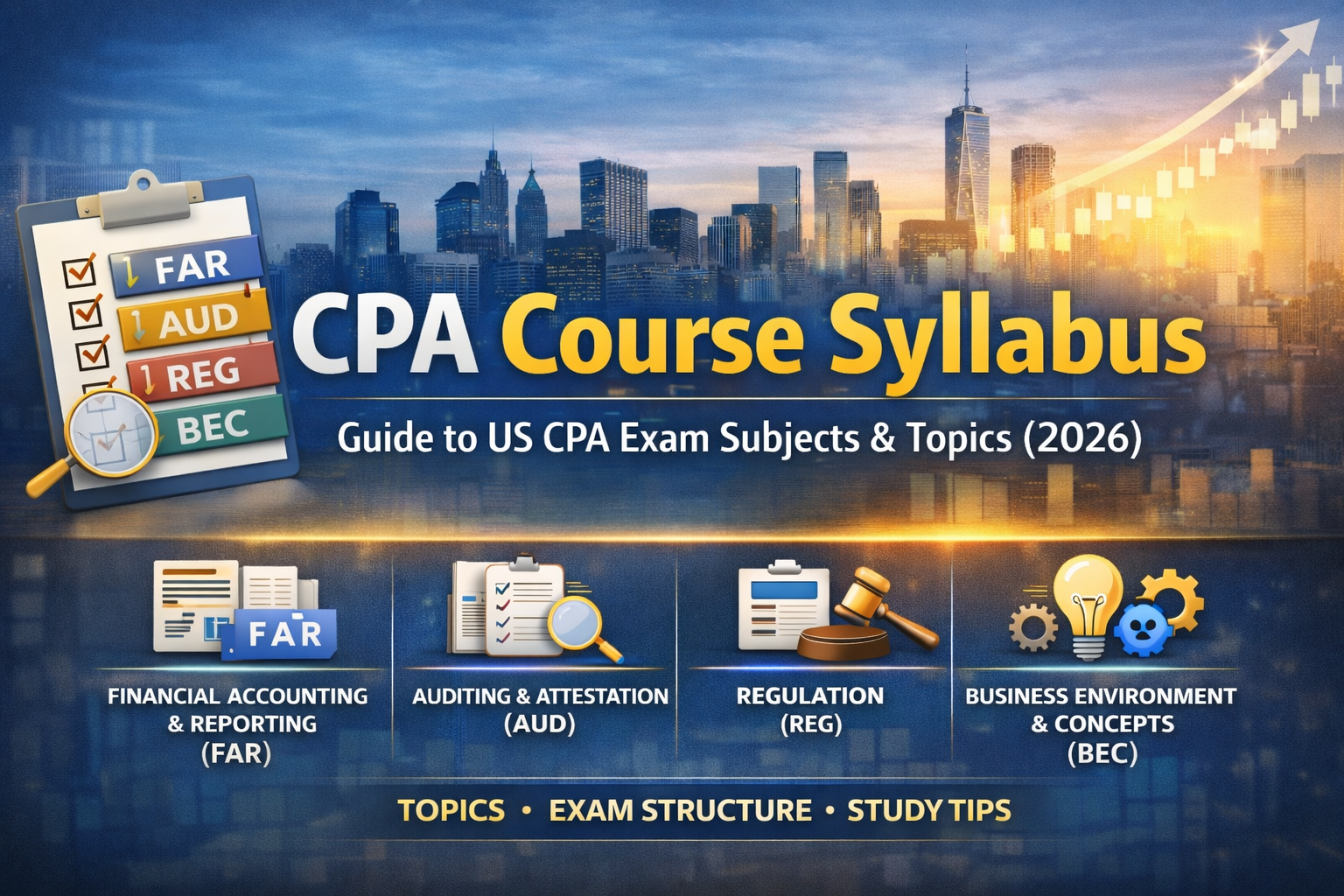
Understanding the CPA course syllabus is the first step toward clearing the US CPA Exam with confidence. The syllabus is designed by the AICPA to test not just accounting knowledge, but also real-world application, professional judgment, and business understanding. In this blog, you’ll get a detailed, student-friendly explanation of the CPA course syllabus, subjects, and exam structure.
What Is the CPA Course Syllabus?
The CPA course syllabus outlines the academic and practical areas tested in the US Certified Public Accountant (CPA) examination. It is divided into four core exam sections, each focusing on a critical competency required of a global accounting professional.
CPA Course Syllabus Overview
The CPA course syllabus consists of the following four subjects:
-
Financial Accounting and Reporting (FAR)
-
Auditing and Attestation (AUD)
-
Regulation (REG)
-
Business Environment and Concepts (BEC)*
*Recent exam updates introduce discipline options, but the core knowledge areas remain aligned with these subjects.
Detailed CPA Course Syllabus (Subject-Wise)
1. Financial Accounting and Reporting (FAR)
FAR is the most extensive part of the CPA course syllabus and focuses on financial reporting standards.
Topics covered:
-
US GAAP framework
-
Financial statements
-
Consolidations & business combinations
-
Governmental and nonprofit accounting
-
IFRS basics
2. Auditing and Attestation (AUD)
AUD evaluates auditing principles, ethics, and assurance services.
Topics covered:
-
Audit planning and risk assessment
-
Internal control systems
-
Audit evidence and reporting
-
Professional ethics and independence
-
Attestation engagements
3. Regulation (REG)
REG in the CPA course syllabus focuses on taxation and business law.
Topics covered:
-
US federal taxation (individuals & entities)
-
Ethics and professional responsibility
-
Business law and contracts
-
Federal regulations and compliance
4. Business Environment and Concepts (BEC)
BEC tests business knowledge and strategic thinking.
Topics covered:
-
Corporate governance
-
Financial management
-
Cost and managerial accounting
-
Economics
-
Information technology systems
CPA Course Syllabus Exam Pattern
Each subject under the CPA course syllabus follows this format:
-
Exam duration: 4 hours per paper
-
Question types: MCQs + Task-Based Simulations
-
Passing score: 75 out of 99
-
Mode: Computer-based exam
Candidates can appear for the exams in any order.
How Long Does It Take to Complete the CPA Course Syllabus?
On average, candidates complete the CPA course syllabus within:
-
12–18 months
-
6–8 weeks of preparation per subject
-
Flexible scheduling across the year
How to Prepare the CPA Course Syllabus Effectively
To master the CPA course syllabus:
-
Follow an AICPA-aligned study plan
-
Focus on concept clarity, not memorization
-
Practice task-based simulations regularly
-
Revise weak areas after mock exams
A disciplined approach is crucial to clearing all four sections.
Why Understanding the CPA Course Syllabus Matters
A clear understanding of the CPA course syllabus helps you:
-
Plan a realistic study timeline
-
Allocate time based on subject weightage
-
Avoid unnecessary study material
-
Improve first-attempt pass chances
Final Thoughts
The CPA course syllabus is comprehensive, practical, and globally relevant. It prepares candidates for high-value roles in accounting, auditing, taxation, and business advisory. With the right strategy and structured preparation, mastering the CPA course syllabus is achievable—even alongside work or college.

 Arabic
 French
 Spanish
 Portuguese
 Deutsch
 Turkish
 Dutch
Dutch
 Italiano
 Russian
 Romaian
 Portuguese (Brazil)
 Greek
Greek