


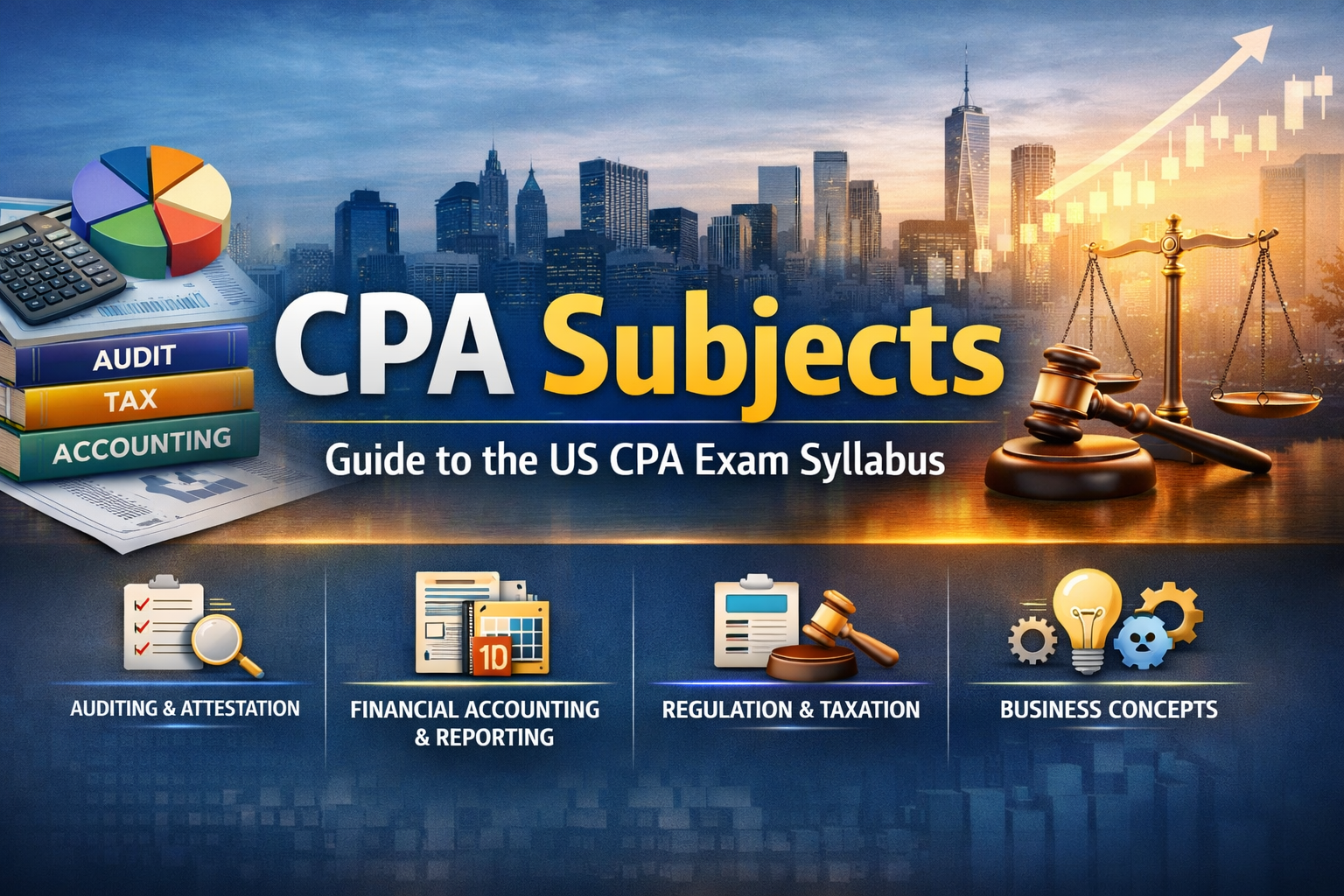
If you’re planning to become a US Certified Public Accountant, understanding CPA subjects is the first and most important step. The CPA Exam is structured into four core papers that test accounting knowledge, auditing skills, business acumen, and regulatory expertise. In this blog, we break down all CPA subjects, their syllabus coverage, and how to prepare strategically.
What Are CPA Subjects?
CPA subjects refer to the four examination sections prescribed by the AICPA (American Institute of Certified Public Accountants). Each subject evaluates a different competency required of modern CPAs, ensuring global relevance and professional rigor.
The four CPA subjects are:
-
Auditing and Attestation (AUD)
-
Financial Accounting and Reporting (FAR)
-
Regulation (REG)
-
Business Environment and Concepts (BEC) (discipline model transition applies in recent exam updates)
List of CPA Subjects Explained
1. Auditing and Attestation (AUD)
This CPA subject focuses on audit procedures, ethics, and professional responsibilities.
Key topics include:
-
Audit planning and risk assessment
-
Internal controls
-
Audit evidence
-
Professional ethics
-
Attestation engagements
AUD tests your analytical and judgment skills, which are critical for assurance roles.
2. Financial Accounting and Reporting (FAR)
FAR is considered the most comprehensive among CPA subjects and covers advanced accounting standards.
Key topics include:
-
US GAAP and IFRS
-
Financial statements
-
Governmental accounting
-
Not-for-profit accounting
-
Consolidations and equity accounting
FAR forms the backbone of accounting expertise for CPAs.
3. Regulation (REG)
REG evaluates your understanding of taxation and business laws in the United States.
Key topics include:
-
Federal taxation (individuals & entities)
-
Ethics and professional responsibility
-
Business law
-
Contracts and commercial transactions
This CPA subject is essential for roles involving tax planning and compliance.
4. Business Environment and Concepts (BEC)
BEC assesses business knowledge and strategic understanding.
Key topics include:
-
Corporate governance
-
Economic concepts
-
Financial management
-
Cost accounting
-
Information technology
Among all CPA subjects, BEC is often considered more conceptual and theory-driven.
CPA Subjects Exam Pattern
Each of the CPA subjects follows a structured exam format:
-
Duration: 4 hours per subject
-
Question types: MCQs, task-based simulations, and written communication (in select sections)
-
Passing score: 75 out of 99
Candidates can take CPA subjects in any order and at their own pace within the exam window.
How to Prepare for CPA Subjects Effectively
To succeed in all CPA subjects, candidates should:
-
Follow a structured study plan (6–12 months total)
-
Use AICPA-aligned study materials
-
Practice mock tests regularly
-
Focus on concept clarity and application
Balancing all CPA subjects with consistent revision is the key to clearing the exam on the first attempt.
Final Thoughts
Understanding CPA subjects gives you clarity on what the US CPA Exam demands and how to plan your preparation efficiently. Each subject builds a unique professional skill set, making the CPA qualification one of the most respected accounting credentials globally.
If your goal is a high-growth career in accounting, auditing, taxation, or finance, mastering CPA subjects is your gateway to global opportunities.

 English
 Arabic
 French
 Spanish
 Portuguese
 Deutsch
 Turkish
 Dutch
Dutch
 Russian
 Romaian
 Portuguese (Brazil)
 Greek
Greek