


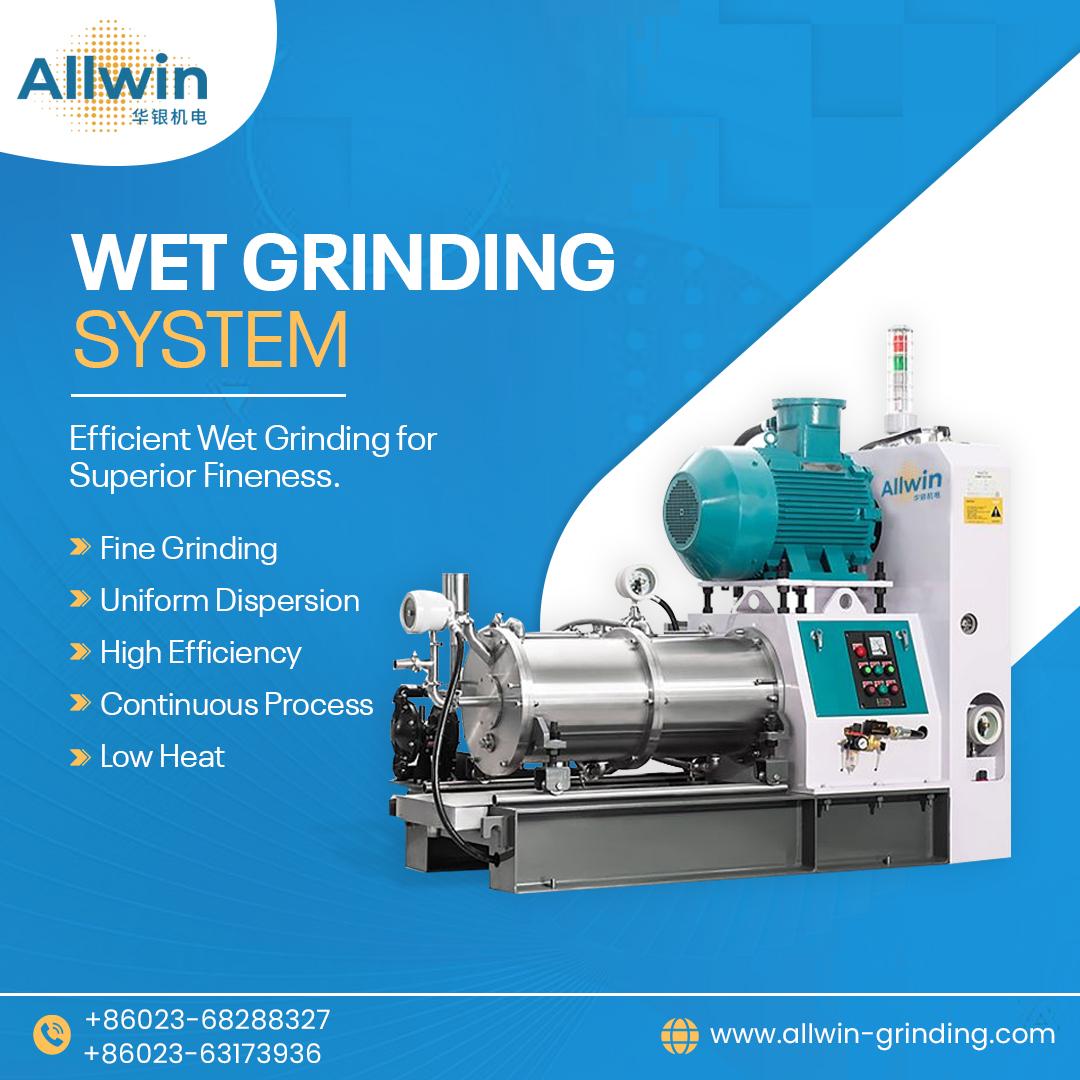
When most people think of grinding, they picture a dusty, noisy process—like crushing rocks or grinding coffee beans. While dry grinding has its place, many of the products we use every day require a much more delicate and precise approach. This is where wet grinding comes into play.
From the ink in your pen to the coating on your car and the medicine in your cabinet, wet grinding is the invisible process that makes modern manufacturing possible. But what exactly is it, and how does it scale from a small experiment to a massive production line?
Wet grinding system refers to the process of grinding down solids that have been dispersed in a liquid environment. This means that instead of using a hammer to crush dry earth on top of dry earth, we would mix the dry soil or whatever we want to grind with a liquid (water, oil, etc.) to form a slurry.
So if we are adding a liquid to our grinding operations what are the major advantages?
1) Temperature Control, when we grind, we create friction and therefore heat. If the materials that we are grinding are heat sensitive (ex: certain chemicals and food), then dry grinding may cause them to catch fire. The liquid in wet grinding helps cool the material that we are grinding so that it does not get too hot.
2) No Dust, when we grind dry, we create hazardous dust that is damaging to our workers and has the potential to explode. When grinding wet, all of the material is contained within the liquid as opposed to being dispersed into the air.
3) To create a Finer Grind, when we grind material we create clusters of particles that cling together. The addition of the liquid when grinding allows for the dispersion of the particles in order to create a much smoother and finer surface than with dry grinding.
The Laboratory Wet Grinding System for the Small Beginning There are not 10,000 gallons of paint made before 1 pint is made.Developing new products costs a considerable amount of money. You do not want to waste large amounts of raw materials just to see if your formula works! The Laboratory wet grinding system are therefore a Research and Development team member's best friend. Essentially, a laboratory wet grinding system is a small version of the large factory machinery found in an industrial facility. A Laboratory wet grinding system can produce a few hundred milliliters of material for testing purposes.
Scientists and engineers want to answer questions such as:
-
What is the best media (bead) to use for grinding the material?
-
How thick or thin is the slurry?
-
How long would it take to obtain the desired particle size?
Once the laboratory equipment has produced sufficient data to confirm the best process, you will have the information you need to scale up appropriately from using this laboratory system. The best laboratory systems are designed to mimic their larger counterparts very closely so that you can feel confident using the results obtained in a laboratory setting will also apply to the results generated in the larger processing equipment.
Expanding the Industry Using Wet Grinding Systems
Once the R&D team approves the process, it will continue to be completed in the manufacturing plant, where the Wet Grinding System will fully be utilized.
An industrial (Wet Grinding) system is based on one concept: to be as efficient as possible, producing large amounts of slurry through continuous operation of machines. Like the laboratory, the physics used by these systems are the same; however, their engineering has a strong emphasis on reliability and throughput.
Industrial Wet Grinding Systems are equipped with automatic pumps, cooling jackets to control heat produced by the large electric motors running at high RPMs, and effective separation devices that allow separating the grinding media from finished products once produced.
Conclusion
Regardless of using a Laboratory wet grinding system for developing new pharmaceutical formulas or a Heavy-Duty wet grinding system for manufacturing agricultural pesticides, the concept remains consistent. Manufacturers produce safer, high-quality, consistent products using liquid as an aide in the breakdown of particles. A smooth solution to a rough issue.

 English
 Arabic
 French
 Spanish
 Deutsch
 Turkish
 Dutch
Dutch
 Italiano
 Russian
 Romaian
 Portuguese (Brazil)
 Greek
Greek