


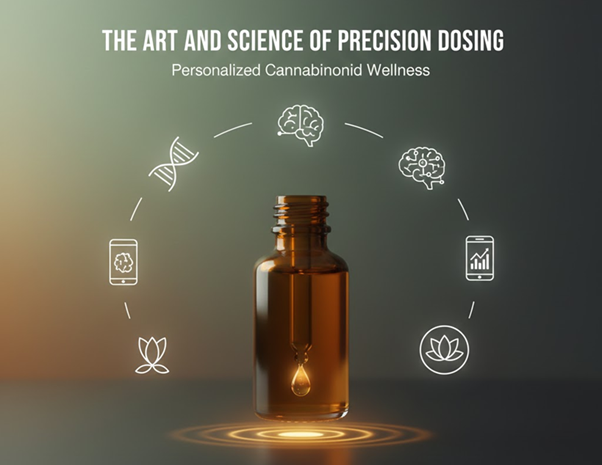
In the world of holistic health, cannabinoids like CBD and THC have emerged as powerful allies for supporting balance in body and mind. Yet, their true potential unfolds only through precise dosing tailored to the individual. This isn't about popping a generic gummy or guessing a milligram count—it's a blend of ancient wisdom and modern science, honoring the body's unique endocannabinoid system (ECS). As a holistic practitioner, I've seen how getting dosing right can shift someone from nagging discomfort to vibrant equilibrium, reminding us that health is deeply personal.
The ECS, discovered in the 1990s, acts as our internal regulator for mood, sleep, pain, inflammation, and more. Cannabinoids interact with its receptors—CB1 in the brain and CB2 in the immune system—mimicking natural compounds like anandamide, the "bliss molecule." But one-size-fits-all approaches fail because factors like genetics, metabolism, body weight, tolerance, and even daily stressors alter how we respond. Precise dosing respects this variability, turning cannabinoids into a tool for empowerment rather than a shot in the dark.
Understanding the Science Behind Variability
Scientific research underscores why precision matters. A 2019 study in Pharmacology highlighted how genetic variations in the CYP450 enzyme family—responsible for metabolizing cannabinoids—affect processing speed. "Fast metabolizers" might need higher doses for effects, while "slow metabolizers" feel potency at lower levels, risking side effects like drowsiness if overdosed. Body composition plays a role too: fat-soluble THC lingers longer in those with higher body fat, extending effects.
Bioavailability is another key puzzle piece. Ingested cannabinoids pass through the liver's "first-pass metabolism," slashing absorption to 6-20%. Sublingual tinctures or vaping boost this to 30-50%, delivering faster, more predictable results. A 2021 review in Frontiers in Pharmacology emphasized entourage effects—the synergy of cannabinoids, terpenes, and flavonoids in full-spectrum products—which amplifies benefits at lower doses compared to isolates.
Enter pharmacokinetics: the study of absorption, distribution, metabolism, and excretion. Peak plasma levels for oral CBD hit around 2-4 hours, lasting 4-6 hours, while THC edibles can take 1-2 hours but persist up to 12. Blood-brain barrier penetration varies, explaining why microdosing (1-5mg) suits subtle support like anxiety relief, per a 2020 Journal of Cannabis Research trial showing 25mg CBD reduced public speaking anxiety without impairment.
The Art of Personalization: Listening to Your Body
Science provides the map, but the art lies in intuitive tuning. Holistic traditions, from Ayurveda’s prakriti (constitution) to Chinese medicine’s qi balance, echo this: what restores one person disrupts another. Start low and go slow—the golden rule. Begin with 1-2mg of CBD daily, titrating up by 1-2mg every 3-5 days while journaling effects on mood, energy, sleep, and any discomfort.
Consider lifestyle layers. A 70kg athlete with inflammation might thrive on 20-40mg CBD post-workout, enhanced by black pepper’s piperine for better absorption. Someone with chronic stress, weighing 55kg and on antidepressants, could find bliss at 5-10mg THC:CBD 1:1 ratios, avoiding cytochrome P450 interactions. Age matters too—older adults process slower, often needing half the dose of younger folks.
I always demonstrate to clients how one cbd drop can make the difference between suboptimal and perfect results, especially when tracking subtle shifts in tension or focus during our sessions.
Tools elevate the craft. Apps like Releaf or Strainprint log strains, doses, and outcomes, building a personal database. Wearables tracking heart rate variability (HRV) signal ECS harmony—rising HRV often follows optimal dosing. Pair this with cycle syncing for women: lower doses in follicular phase, higher in luteal for hormonal flux.
Methods for Precision Dosing
Achieving accuracy demands reliable delivery. Here's a breakdown:
● Tinctures and Oils: Gold standard for control. A standard dropper holds 0.5ml; at 1000mg/30ml, that's ~16mg per dropper-full. Use a precise pipette for microdoses.
● Capsules and Edibles: Convenient but less flexible. Pre-measure and avoid mixing with fatty meals that spike absorption unpredictably.
● Topicals: Ideal for localized pain—0.5-2% CBD creams bypass systemic effects, dosing by surface area.
● Vaping/Inhalation: Fastest onset (5-10 minutes), but lung health limits frequency. Nano-emulsified options improve water solubility for 50%+ bioavailability.
Lab-tested products with certificates of analysis (COAs) are non-negotiable—verifying potency, purity, and contaminants like pesticides or heavy metals. Full- or broad-spectrum often outperforms isolates due to entourage synergy, as shown in a 2022 Cannabis and Cannabinoid Research study where full-spectrum CBD eased epilepsy seizures at half the dose.
Common Pitfalls and How to Avoid Them
Overdosing looms large, especially with potent edibles misleadingly labeled. Symptoms like dry mouth, fatigue, or paranoia signal excess—counter with CBD to mellow THC or lemon (limonene) for detox. Underdosing frustrates, often from poor-quality products or ignoring tolerance buildup; cycle off weekly to reset.
Interactions warrant caution. CBD inhibits CYP450, potentially amplifying blood thinners or statins—consult a practitioner. THC impairs driving; dose 4+ hours pre-bed for sleep.
Legal landscapes vary—U.S. Farm Bill caps hemp CBD at 0.3% THC federally, but states differ. Globally, medical cannabis programs demand prescriptions for precision.
Real-World Applications and Evidence
Precision shines in practice. For chronic pain, a 2023 Pain Medicine meta-analysis found personalized CBD dosing (mean 25mg/day) rivaled opioids with fewer side effects. Anxiety trials, like a 2019 Brazilian Journal of Psychiatry study, pegged 300mg single-dose efficacy, but responders averaged 150mg via titration.
Sleep optimization favors low-dose THC (2.5mg) with CBD (15mg), per 2021 research in Journal of Clinical Sleep Medicine, enhancing deep sleep without grogginess. Neuroprotection for conditions like multiple sclerosis benefits from Sativex's 1:1 spray, dosed to symptom relief.
Athletes leverage CBG for focus—5-10mg pre-training boosts recovery via anti-inflammatory CB2 modulation. Even gut health responds: microdosed CBD supports microbiome balance, reducing IBS flares in anecdotal reports backed by emerging rodent studies.
Crafting Your Protocol: A Step-by-Step Guide
- Assess Baseline: Weigh yourself, note medications, track symptoms for 3 days.
- Select Product: COA-verified, matching goal (e.g., high-CBD for calm).
- Start Micro: 0.25-1mg/kg body weight, sublingual hold 60-90 seconds.
- Titrate Mindfully: Increase 25-50% every 3 days; plateau at efficacy.
- Monitor and Adjust: Journal + biometrics; tweak for time of day or cycle.
- Cycle and Consult: 4-6 weeks on, 1 week off; pair with holistic habits like breathwork.
Embracing the Journey
Precise cannabinoid dosing marries empirical data with embodied wisdom, fostering resilience over quick fixes. It's not just about milligrams—it's recalibrating your inner harmony. As research evolves, from AI-driven dosing algorithms to personalized genomics, the future promises even finer tuning. Listen to your body, honor the science, and let cannabinoids guide you toward wholeness.

 English
 Arabic
 French
 Spanish
 Portuguese
 Deutsch
 Dutch
Dutch
 Italiano
 Russian
 Romaian
 Portuguese (Brazil)
 Greek
Greek