


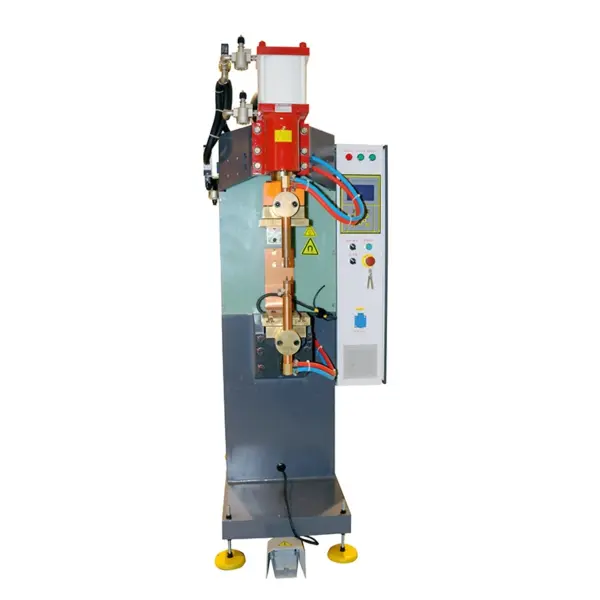
In today’s high-speed manufacturing environment, precision, repeatability, and efficiency are more critical than ever. Capacitor discharge welding (CD welding) has emerged as a go-to solution for industries requiring fast, reliable, and high-quality metal joining. From automotive to electronics and battery production, this advanced resistance welding technique enables manufacturers to achieve strong, clean, and consistent welds in a fraction of the time compared to traditional methods.
At Heron Welder, we specialize in delivering world-class capacitor discharge welding machines and automation solutions tailored for OEMs, industrial fabricators, and production line integrators. In this guide, we’ll explore how CD welding works, its industrial applications, key advantages, and best practices for implementation.
What Is Capacitor Discharge Welding?
Capacitor discharge welding is a form of resistance welding where energy stored in a high-capacity capacitor bank is rapidly discharged through the workpiece to create a weld. Unlike conventional spot welding, which uses a continuous current over a longer period, CD welding delivers an extremely short, high-intensity pulse typically in the range of milliseconds.
How It Works
-
Energy Storage – A bank of capacitors is charged to a high voltage.
-
Discharge Pulse – The stored electrical energy is released almost instantaneously through electrodes positioned on the workpiece.
-
Localized Heating – The sudden current flow generates resistive heat at the contact point between metals, melting the interface.
-
Solid-State Joining – As the energy dissipates, the molten zone solidifies, forming a strong weld without excessive heat spread.
The result is a high-quality weld with minimal thermal distortion, making CD welding ideal for thin or delicate components.
Key Applications of Capacitor Discharge Welding
Capacitor discharge welding is widely used in industries where speed, precision, and repeatability are paramount:
-
Automotive Battery Manufacturing – Welding thin copper, aluminum, or nickel tabs in lithium-ion battery packs.
-
Electronics and Electrical Components – Joining small, delicate parts like terminals, connectors, and micro components.
-
Automotive and Aerospace Fabrication – Attaching small brackets, studs, or clips without compromising adjacent materials.
-
Fastener and Hardware Production – Manufacturing studs, pins, and rivets with consistent weld quality.
Heron Welder’s capacitor discharge welding systems are engineered to integrate seamlessly into automated production lines, ensuring high throughput while maintaining strict quality standards.
Advantages of Capacitor Discharge Welding
Compared to traditional resistance or MIG/TIG welding, CD welding offers several unique benefits:
-
Ultra-Fast Cycle Times – Welds are completed in milliseconds, reducing production time significantly.
-
Minimal Heat Affected Zone (HAZ) – Short pulses prevent damage to surrounding material, ideal for thin metals.
-
High Repeatability – Consistent energy delivery ensures uniform weld quality, critical for mass production.
-
No Filler Material Needed – Eliminates the need for additional materials, reducing cost and complexity.
-
Compatibility with Automation – Perfectly suited for robotic or automated welding systems, including integration with spot welding guns, controllers, and conveyor systems.
Heron Welder’s systems also feature precise pulse control, advanced monitoring, and quality verification to guarantee each weld meets exacting industry standards.
CD Welding vs. Traditional Spot Welding
| Feature | Capacitor Discharge Welding | Conventional Spot Welding |
|---|---|---|
| Pulse Duration | Milliseconds | Seconds |
| Heat Affected Zone | Minimal | Larger, risk of distortion |
| Material Thickness | Thin to medium | Medium to thick |
| Automation Compatibility | High | Moderate |
| Speed | Ultra-fast | Slower |
| Applications | Electronics, battery tabs, precision fasteners | Structural steel, automotive panels |
This comparison highlights why manufacturers seeking precision and speed increasingly prefer CD welding for high-volume, delicate assemblies.
Best Practices for Capacitor Discharge Welding
To maximize the performance and longevity of CD welding equipment, follow these best practices:
-
Proper Electrode Maintenance – Regularly inspect and replace electrodes to ensure consistent energy delivery.
-
Material Preparation – Clean, deburred, and flat surfaces improve weld quality and repeatability.
-
Correct Pulse Settings – Adjust voltage, capacitance, and discharge time according to material type and thickness.
-
Integration with Automation – Use robotic arms or conveyors for high-volume production to improve throughput and safety.
-
Monitoring and Quality Control – Implement real-time monitoring to detect variations in resistance, current, or weld formation.
Heron Welder’s solutions come equipped with advanced controllers and automation-ready interfaces, enabling seamless implementation and high reliability.
Why Choose Heron Welder for CD Welding
As a global leader in industrial welding and metal-joining technologies, Heron Welder combines innovation with hands-on expertise. Our capacitor discharge welding systems are designed to:
-
Deliver consistent, high-quality welds for delicate and high-volume applications.
-
Integrate into automated production lines for maximum efficiency.
-
Provide precise control over pulse parameters, energy, and timing.
-
Offer robust service, technical support, and training for factory engineers and line integrators.
With decades of experience in resistance welding, FSPR, clinching, and automated production solutions, Heron Welder is a trusted partner for OEMs, contract manufacturers, and automation integrators worldwide.
Frequently Asked Questions (FAQs)
Q1: Can CD welding join dissimilar metals?
Yes. CD welding can effectively join metals like copper-to-steel or aluminum-to-copper, provided pulse parameters are optimized for material conductivity and thickness.
Q2: What is the typical thickness range for CD welding?
CD welding is ideal for thin to medium materials, typically ranging from 0.1 mm to 3 mm, depending on metal type and equipment specifications.
Q3: How does CD welding integrate with automated lines?
CD welding systems can be equipped with robotic arms, conveyors, and vision systems, allowing fully automated, high-speed production with minimal operator intervention.
Q4: Is filler material required for CD welding?
No, CD welding is a solid-state process and does not require any filler, flux, or shielding gas, reducing cost and complexity.
Q5: How does CD welding affect surrounding components?
Due to the extremely short discharge pulse, the heat-affected zone is minimal, protecting nearby delicate components from thermal damage.
Take Your Welding to the Next Level with Heron
Whether you’re producing battery packs, electronic assemblies, or precision fasteners, capacitor discharge welding offers unmatched speed, precision, and reliability. At Heron Welder, we provide fully customizable solutions from standalone machines to fully automated production lines tailored to your unique manufacturing requirements.
Request a quote today or consult with our engineering team to explore how Heron’s capacitor discharge welding systems can transform your production process. Let us help you achieve superior weld quality, faster cycle times, and reliable automation integration.

 English
 Arabic
 Spanish
 Portuguese
 Deutsch
 Turkish
 Dutch
Dutch
 Italiano
 Russian
 Romaian
 Portuguese (Brazil)
 Greek
Greek