


Introduction
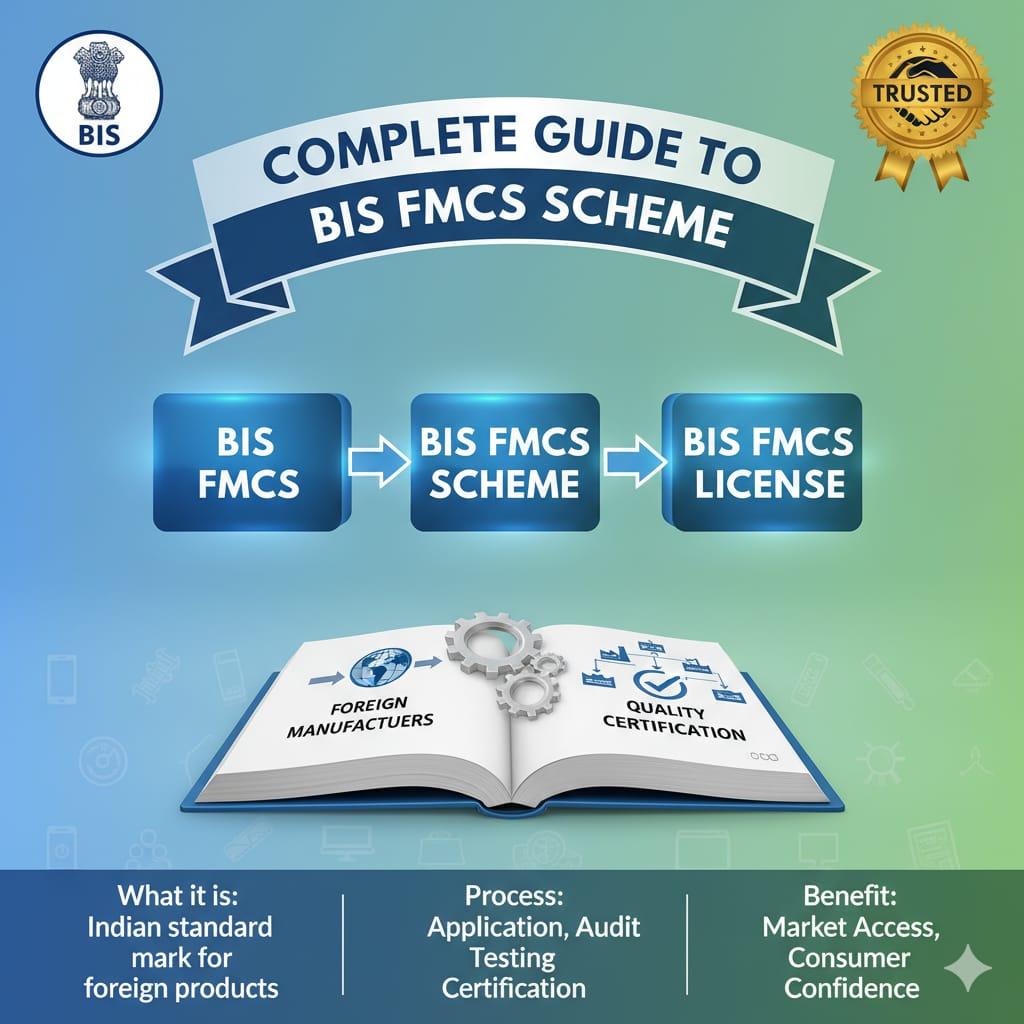
The BIS FMCS Certificate is an essential certification issued by the Bureau of Indian Standards (BIS) under the FMCS (Foreign Manufacturers Certification Scheme). This certification allows foreign manufacturers to legally export and sell their products in the Indian market while ensuring compliance with Indian quality standards.
The BIS FMCS Certificate is designed specifically for foreign manufacturers who want to access India’s growing market. Obtaining this certification demonstrates that a manufacturer’s product meets the prescribed Indian standards, ensuring safety, reliability, and consumer trust.
Understanding BIS FMCS Certification
BIS FMCS Certification is a recognition that a foreign manufacturer complies with the specific Indian standards outlined for their product category. Unlike the traditional BIS certification process for Indian manufacturers, FMCS is tailored for products manufactured outside India but intended for sale within India.
Key features of BIS FMCS Certification include:
-
Legality: Allows foreign manufacturers to sell products in India legally.
-
Quality Assurance: Confirms that products meet Indian standards.
-
Market Access: Facilitates easier entry into the Indian market.
-
Consumer Trust: Enhances the credibility of foreign brands among Indian consumers.
Products Covered Under BIS FMCS
The BIS FMCS Certification covers a wide range of products, including:
-
Electrical appliances and equipment
-
Electronics and IT products
-
Telecommunication devices
-
Safety and protective equipment
-
Consumer goods such as kitchen appliances
Each product category has a defined standard that must be adhered to. Manufacturers must ensure their products meet these requirements to qualify for certification.
BIS FMCS Certification Process
The process to obtain BIS FMCS Certificate is straightforward but requires careful documentation and compliance:
-
Application Submission: The manufacturer submits an application through BIS along with relevant documents like product specifications, test reports, and quality manuals.
-
Product Testing: BIS may require product samples to be tested in an accredited laboratory to verify compliance with Indian standards.
-
Factory Inspection: BIS officials may inspect the foreign manufacturing facility to assess production quality and processes.
-
Grant of Certification: Once the product and facility meet the standards, BIS issues the FMCS Certificate, allowing the product to be legally sold in India.
-
Surveillance: BIS conducts periodic inspections to ensure continued compliance with the standards.
Benefits of BIS FMCS Certificate
Obtaining BIS FMCS Certificate offers several benefits for foreign manufacturers:
-
Regulatory Compliance: Avoids legal issues while selling in India.
-
Competitive Advantage: Certified products gain a competitive edge in the Indian market.
-
Enhanced Reputation: Improves brand image and consumer confidence.
-
Market Expansion: Facilitates wider distribution across India.
-
Long-term Partnerships: Helps in establishing trusted relationships with Indian importers and distributors.
Common Challenges in BIS FMCS Certification
While the process is clear, foreign manufacturers may face certain challenges:
-
Documentation Complexity: Preparing accurate and complete documents can be time-consuming.
-
Testing Delays: Product testing in accredited labs may take additional time.
-
Factory Inspection Coordination: Scheduling inspections with BIS officials may require logistical planning.
-
Regulatory Updates: Staying updated with changes in Indian standards is crucial.
These challenges can be minimized by consulting experienced BIS certification service providers who guide manufacturers through every step.
Role of BIS Certification Service Providers
Service providers like sunconsultants.co.in can help streamline the BIS FMCS Certification process. Their services include:
-
Assisting with application preparation and submission
-
Coordinating product testing with accredited laboratories
-
Scheduling and facilitating factory inspections
-
Ensuring compliance with all BIS standards
-
Offering post-certification support for renewals and surveillance audits
Using professional guidance significantly reduces errors and accelerates certification timelines.
Conclusion
The sunconsultants.co.in. is an essential requirement for foreign manufacturers aiming to enter the Indian market. It ensures that products comply with Indian quality standards, builds consumer trust, and allows legal market access. While the certification process may involve sunconsultants.co.in.

 English
 Arabic
 Spanish
 Portuguese
 Deutsch
 Turkish
 Dutch
Dutch
 Italiano
 Russian
 Romaian
 Portuguese (Brazil)
 Greek
Greek