


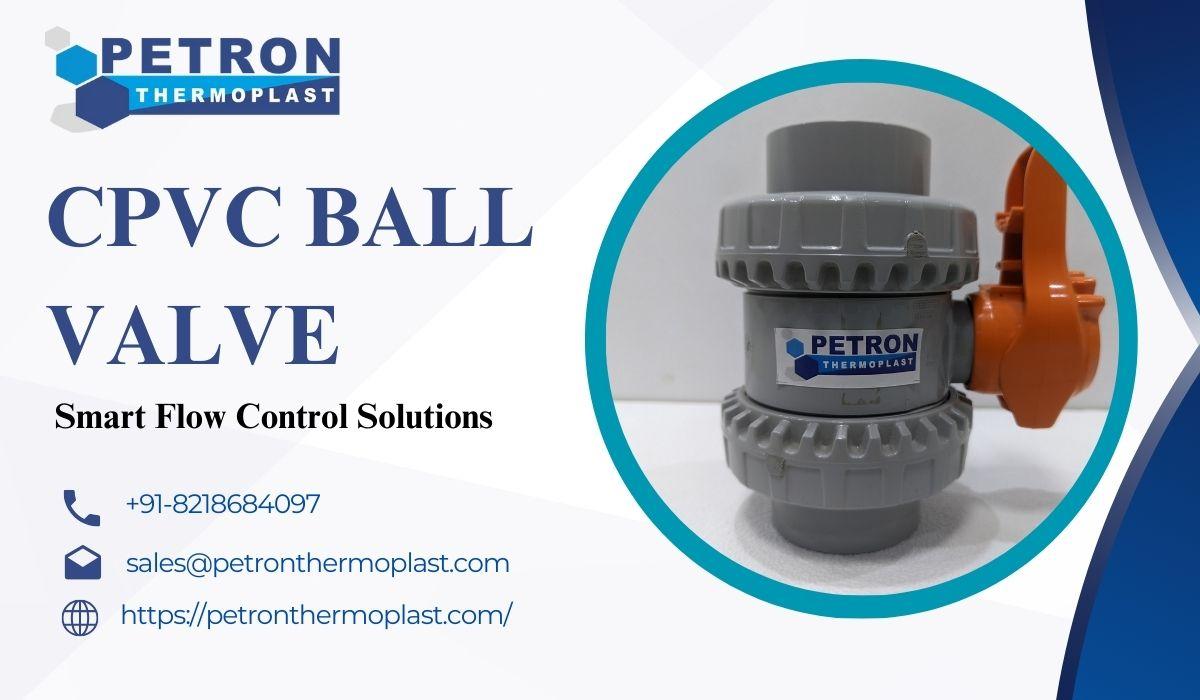
Industrial fluid handling systems demand absolute reliability, precision flow control, and long-term durability—especially when operating in corrosive, high-temperature, or chemically aggressive environments. Industrial CPVC ball valves have become a preferred choice across multiple industries due to their smooth operation, excellent chemical resistance, and consistent performance over extended service life.
At Petron Thermoplast, we manufacture and supply industrial-grade CPVC ball valves engineered to meet the demanding requirements of chemical processing plants, water treatment facilities, utility systems, and export-oriented industrial projects.
Understanding CPVC Ball Valve Technology
CPVC (Chlorinated Polyvinyl Chloride) is a thermoplastic material specifically designed to handle higher temperatures and aggressive chemicals compared to standard PVC. CPVC ball valves utilize a rotating spherical ball with a central bore to control fluid flow, providing quick quarter-turn operation and tight shut-off.
The combination of CPVC material strength and ball valve design efficiency ensures smooth, low-torque operation even in challenging industrial environments.
Why Smooth Operation Matters in Industrial Valves?
Smooth and reliable valve operation is essential in industrial pipelines for several reasons:
- Prevents pressure shocks and flow disturbances
- Reduces wear on seals and valve components
- Enhances operator safety
- Minimizes downtime and maintenance costs
Key Advantages of Industrial CPVC Ball Valves
1. Superior Chemical Resistance
CPVC ball valves are resistant to a wide range of corrosive chemicals, including acids, alkalis, salts, and industrial process fluids. This makes them ideal for chemical processing and corrosive fluid handling applications.
2. Smooth Quarter-Turn Operation
The ball valve mechanism allows fast, effortless operation with minimal force. This smooth movement reduces stress on internal components and ensures precise flow control.
3. High Temperature Capability
CPVC can operate at higher temperatures compared to PVC, making these valves suitable for hot water, chemical processing, and industrial heating systems.
4. Leak-Proof Sealing
Precision-molded valve seats ensure tight shut-off, preventing leaks even under fluctuating pressure conditions.
5. Corrosion-Free Performance
Unlike metal valves, CPVC ball valves do not rust, scale, or corrode, ensuring long-term operational reliability.
Design Features That Ensure Reliable Performance
Full-Bore Valve Design
Full-bore CPVC ball valves allow unrestricted flow, reducing pressure drop and energy loss across the system.
High-Quality Sealing Materials
Advanced sealing elements ensure smooth ball rotation and consistent sealing performance.
Robust Valve Body Construction
Industrial CPVC ball valves are designed to withstand internal pressure, mechanical stress, and temperature fluctuations.
Low Torque Operation
Optimized internal geometry reduces operating torque, making the valves easy to operate manually or with actuators.
Threaded, Socket & Flanged Ends
Available in multiple end connections for seamless integration into industrial piping systems.
Applications of Industrial CPVC Ball Valves
Chemical Processing Plants
Used for controlling corrosive chemicals, solvents, and process fluids with precision and safety.
Water Treatment Facilities
Ideal for clean water, chemical dosing, and filtration systems due to their corrosion resistance.
Utility & Infrastructure Systems
Reliable flow control in industrial water supply and distribution networks.
Pharmaceutical & Specialty Chemical Industries
CPVC ball valves ensure contamination-free fluid handling in sensitive production environments.
Cooling & Heating Systems
Suitable for chilled water, hot water, and industrial cooling circuits.
CPVC Ball Valves vs Metal Valves
| Feature | CPVC Ball Valves | Metal Valves |
| Corrosion Resistance | Excellent | Limited |
| Maintenance | Low | High |
| Weight | Lightweight | Heavy |
| Chemical Compatibility | High | Moderate |
| Cost Efficiency | High | Lower over time |
Quality & Performance Standards
Industrial CPVC ball valves from Petron Thermoplast are manufactured under strict quality control processes to ensure consistent performance and long service life. Each valve is tested for:
- Pressure integrity
- Smooth operational torque
- Leak-proof sealing
- Dimensional accuracy
Export Grade CPVC Ball Valves for Global Projects
Petron Thermoplast supplies export-quality CPVC ball valves to international markets, including the Middle East, Africa, and Asia. Our valves are designed to perform reliably under diverse environmental and operational conditions.
We support:
- EPC contractors
- Industrial exporters
- Water & utility projects
- Chemical processing plants
Why Choose Petron Thermoplast?
Petron Thermoplast is a trusted manufacturer and supplier of industrial CPVC ball valves with a strong focus on performance, safety, and reliability.
Our Strengths:
- Precision manufacturing technology
- Industrial-grade CPVC materials
- Consistent product quality
- Customization options
- Competitive pricing for domestic & export markets
Maintenance & Operational Benefits
CPVC ball valves require minimal maintenance due to their corrosion-free nature and smooth operation. Routine inspections and basic operational checks are typically sufficient to ensure continued performance. Their ease of operation also reduces operator fatigue and improves overall system efficiency.
Sustainability & Cost Efficiency
CPVC ball valves contribute to sustainable industrial operations by:
- Reducing chemical leakage
- Lowering maintenance frequency
- Extending service life
- Minimizing system downtime
Conclusion
Industrial CPVC ball valves with smooth and reliable operation are an essential component of modern industrial piping systems. Their superior chemical resistance, effortless operation, and long-term durability make them a smart choice for chemical processing, water treatment, and utility applications. By choosing Petron Thermoplast, industries gain access to expertly engineered CPVC ball valves that meet global quality expectations and deliver consistent performance under demanding conditions.

 English
 French
 Spanish
 Portuguese
 Deutsch
 Turkish
 Dutch
Dutch
 Italiano
 Russian
 Romaian
 Portuguese (Brazil)
 Greek
Greek