


Let me be honest with you. When I first started tracking Remote data science jobs a few years ago, I thought the surge was temporary. A pandemic-era bubble. Something that would quietly deflate once the world got back to normal. I was wrong. Spectacularly, beautifully, data-provably wrong.
In 2026, remote data science jobs are not just surviving. They are thriving, multiplying, and frankly, showing no signs of slowing down. If you have been sitting on the fence about whether to invest in your Data Science skills, I want you to read every single word of this blog. Because the numbers, the trends, and the real-world job listings will tell you a story that no career counselor ever told you this clearly.
The Numbers Do Not Lie
Let us start with what the data actually says, because we are data scientists and we do not traffic in opinions when we have metrics.
A single snapshot of job listings on one major platform in India alone shows over 319 remote data science jobs actively posted. That is not 319 jobs in a country. That is 319 jobs on one platform, in one snapshot, in one geography. Globally, that number scales into the tens of thousands.
Breaking down the salary distribution from current listings:
- 0 to 3 Lakhs INR: 17 jobs
- 3 to 6 Lakhs INR: 108 jobs
- 6 to 10 Lakhs INR: 191 jobs
- 10 to 15 Lakhs INR: 140 jobs
Notice something? The bulk of remote data science jobs cluster in the 6 to 15 lakh range. That is not entry-level pocket money. That is a serious, career-defining salary band, and it is all remote. You could be sitting in a small town in Karnataka, a flat in Lagos, or a café in Lisbon and compete for the exact same role.
Why Remote Data Science Jobs Exploded and Never Came Back Down
Here is the part that surprises most people. Remote work in data science did not survive because companies were being generous. It survived because it made mathematical sense for employers.
Data science is fundamentally a laptop job. You need compute power, internet, brainpower, and good coffee. None of those require a specific ZIP code. When companies discovered that their data science teams performed equally well or better from home, the incentive to force them back into offices evaporated.
Add to that the global talent shortage. There are not enough skilled data scientists in any single city to fill the demand. Companies in San Francisco need talent from Hyderabad. Startups in Berlin are hiring from Nairobi. Remote work is not a perk anymore. It is a talent acquisition strategy.
The job listings confirm this. Out of 319 remote data science jobs in the dataset I am working from, 311 are fully remote. Only 8 require work from office. That is a 97.5 percent remote rate. Let that sink in.
What Roles Are Actually Available?
Let me walk you through the real role categories because data science is not one job. It is a galaxy of specialisations, and knowing which star to reach for changes everything.
The role category breakdown looks like this:
- Data Science and Machine Learning: 124 jobs
- Software Development (data-adjacent): 91 jobs
- Business Intelligence and Analytics: 54 jobs
- DBA and Data Warehousing: 8 jobs
So if you are purely interested in machine learning and AI work, you have 124 roles competing for your attention right now. That is not a niche. That is a highway.
Some specific roles that appear in current listings include AI ML Engineer, Principal Engineer for Data Science, Data Scientist in biomedical signal processing, NLP Data Scientist, Data Scientist for connected vehicle technology, and Lead Data Scientist for patient analytics and MLOps. This range tells you something important: data science has matured beyond generic model building. Specialisation is now a career superpower.
The Experience Paradox: Entry Level Is Not Dead
One of the biggest myths I hear from newcomers is this: "All the remote data science jobs require five-plus years of experience. There is nothing for freshers."
Wrong. Completely, demonstrably wrong.
Looking at the listings, Numerator is actively hiring for a Data Scientist role with zero to two years of experience. Netomi lists a Data Scientist I position requiring one to six years. Nybl is open to one to four years. Mapup accepts one to ten years, which is arguably the most flexible range I have ever seen in a job description.
Yes, some roles like Principal Engineer at Nagarro require five to nine years, and the G2TechSoft listing goes all the way to thirty years of experience on the upper end. But the entry points exist. They are real. You just need to be qualified enough to walk through the door.
And that brings me to the most important part of this entire blog.
Why Certification Is the Real Game Changer in 2026
Here is a scenario I want you to think about. Two candidates apply for the same remote data science job. Both have some project experience. Both know Python. Both have done a data science project or two on GitHub. The difference? One has a recognised Data Science Certification. The other does not.
Who gets the callback? Nine times out of ten, it is the one with the credential. Not because the piece of paper magically makes them smarter. But because in a world of 500 applicants per remote role, a certification is a signal. It tells a recruiter that this person was serious enough to go through a structured, evaluated, externally validated learning programme.
This is exactly why platforms like IABAC have become so relevant in 2026. IABAC, which stands for International Association of Business Analytics Certifications, offers globally recognised Data Science Certifications that are designed specifically for this market. Their certifications are not just theoretical tick-boxes. They are built around industry-relevant competencies, covering everything from statistical modelling and machine learning to data visualisation and deployment pipelines.
If you want to explore what is available, the IABAC certification page at https://iabac.org/certifications is worth bookmarking. Their dedicated data science certification path at https://iabac.org/data-science-certification is particularly relevant if you are targeting the roles I have described in this blog.
The Department Breakdown: Where Is the Action?
Let us look at where these remote data science jobs are sitting within company structures, because this tells you which industries are betting hardest on data.
- Data Science and Analytics department: 183 jobs
- Engineering, Software and QA: 110 jobs
- Research and Development: 5 jobs
- IT and Information Security: 3 jobs
The dominance of the Data Science and Analytics department is not surprising. What is interesting is the strong showing from Software and QA, which tells you that traditional engineering teams are absorbing data science capabilities rapidly. The lines between software engineer and data scientist are blurring in ways that create massive opportunity for people who can code and model simultaneously.
Which Skills Are Employers Actually Asking For?
Reading through the job listings carefully, a pattern emerges. Here are the skills that appear most frequently across remote data science jobs in 2026:
Machine learning is mentioned in almost every listing. Python is nearly universal. SQL appears consistently. Natural language processing shows up repeatedly, especially as LLMs have become embedded in product workflows. Signal processing is rising, particularly in health tech. Time series analysis is mentioned multiple times for forecasting and anomaly detection roles. GCP and cloud architecture appear in senior roles. MLOps and model deployment are fast becoming baseline expectations rather than nice-to-haves.
One listing from Pharmsight sums it up beautifully: they want experience with model deployment, productionisation, and monitoring. That phrase alone tells you where the industry has moved. Building a model is table stakes. Deploying it, monitoring it, and keeping it accurate in production is the real skill gap.
A Simple Framework: The Data Science Job Readiness Equation
Let me give you a mental model I use when advising people on entering this field.
Your employability in remote data science in 2026 can be thought of as a function of four variables:
Technical Depth multiplied by Domain Specialisation, added to Portfolio Evidence, multiplied by Credential Signal.
If any one of these is zero, the product suffers. You can have great technical depth but no domain focus and become a generalist competing in a crowded middle. You can have a credential but no portfolio and fail the practical skills test. You can have a portfolio with no certification and lose to someone equally skilled who has one.
The sweet spot is all four, and the good news is that each one is achievable through deliberate effort. A well-structured data science project on GitHub, a domain focus on healthcare or fintech or connected vehicles, foundational to intermediate Python and ML skills, and a recognised certification from a body like IABAC covers all four dimensions.
The Company Type Breakdown: Who Is Hiring Data Science Jobs Remotely?
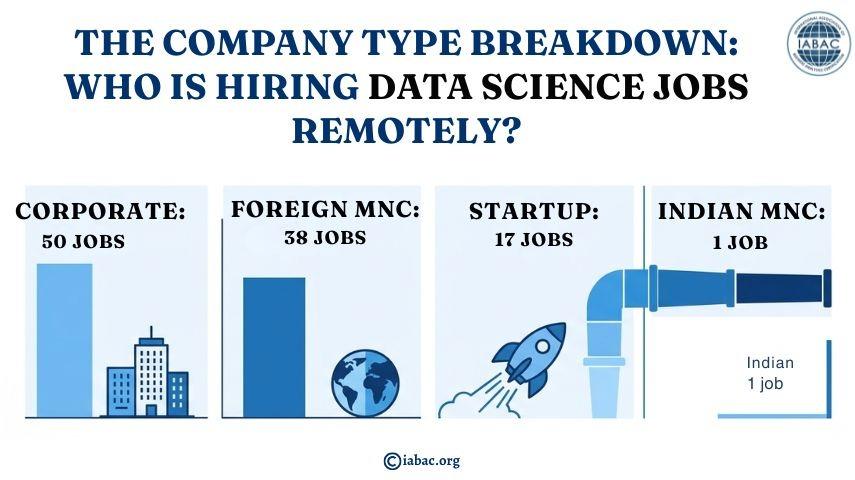
Here is something that will surprise you. When you look at the types of companies offering remote data science jobs:
- Corporate: 50 jobs
- Foreign MNC: 38 jobs
- Startup: 17 jobs
- Indian MNC: 1 job
Foreign multinationals are a major source of remote work. This is the global talent pipeline in action. A company headquartered in the United States or Europe is hiring data scientists in India, Southeast Asia, and Africa because the talent is excellent and the model works. This is genuinely transformative for people in emerging markets who previously had no access to these salary levels and career trajectories.
The Education Reality Check
The listings show that employers are accepting a fairly wide educational net:
- Any Postgraduate: 279 jobs
- Any Graduate: 297 jobs
- B.Tech or B.E.: 14 jobs
- LLM specialisation: 20 jobs
The most important line here is "Any Graduate" covering 297 jobs. This means a commerce graduate, an arts graduate, or a science graduate with the right skills and certifications is technically eligible for the majority of remote data science jobs listed. The field has never been more accessible from an academic entry point perspective.
But accessible does not mean easy. The bar for skills is real, and that is why structured learning and certification through recognised programmes matters more than ever.
The Biomedical and Niche Opportunity
I want to call out something that most generic career guides miss entirely. There are two listings from IT Sphere specifically focused on biomedical signal processing and real-time model deployment for health tech. These are not commodity roles. They require knowledge of EEG data, time series analysis, physiological datasets, and domain-specific machine learning.
Roles like these pay significantly above average and have far less competition because the skill combination is rare. If you are someone with a background in biology, medicine, or signal processing and you layer data science skills on top, you are not competing in a crowded market. You are in a market of one.
This is the future of data science: not generic, not interchangeable, but deeply specialised and globally distributed.
What Does 2026 Look Like Going Forward?
Based on the trajectory I am seeing, remote data science jobs in 2026 are not at the peak of demand. They are still climbing. Here is why I believe that.
Generative AI has not reduced the need for data scientists. It has changed what they do. Every company that adopts an AI product needs someone who can evaluate it, fine-tune it, integrate it, monitor it, and explain its outputs. That someone is a data scientist. The rise of connected vehicles, healthcare AI, demand forecasting, and customer analytics means that domain-specific data science is a growth area for at least the next decade. The listings from Codvo on connected vehicle data science and from Pharmsight on pharma analytics are early signals of a much larger wave.
The professionalisation of the field through certifications and structured learning, particularly through bodies like IABAC at https://iabac.org/data-science-certification, means that the workforce is getting more credentialed and more specialised. Employers respond to that by raising expectations and raising salaries simultaneously.
The Honest Conclusion
Remote data science jobs are in high demand in 2026. Not as a rumour, not as wishful thinking, but as a measurable, documented, listing-backed reality. Over 319 open roles on a single platform in one market. A 97.5 percent remote work rate. Salaries up to 15 lakhs and beyond for experienced professionals. Entry-level opportunities for graduates with the right skills. Global employers actively recruiting across borders.
The question was never really whether the demand exists. The question is whether you are building the skills, the portfolio, the domain knowledge, and the certification that makes you the person employers want to hire.
From data to data, from raw information to actionable insight, from a student with a laptop to a remote data scientist working for a global company, the pathway is real. It is not short. It is not guaranteed. But it is absolutely open.
The only thing left to do is walk through it.


 English
 Arabic
 French
 Spanish
 Portuguese
 Deutsch
 Dutch
Dutch
 Italiano
 Russian
 Romaian
 Portuguese (Brazil)
 Greek
Greek