


A few years ago, many people thought Artificial Intelligence (AI) was something only large technology companies worked on. It seemed like a complex topic meant for researchers and engineers in laboratories. Data Science also felt like a specialized area for statisticians who enjoyed working with spreadsheets and writing code all day.
In 2026, that idea has completely changed.
Today, Data Science and Artificial Intelligence are part of everyday life. They help doctors identify diseases earlier, support banks in detecting fraud, assist retailers in understanding customer behavior, and allow manufacturers to reduce waste. When you receive a movie recommendation, use a voice assistant, or notice your email spam folder catching unwanted messages, you are seeing artificial intelligence and data science in action. The reason these technologies are so important is simple: organizations are collecting enormous amounts of information, but raw data alone has little value. Data Science turns that information into useful insights, and AI uses those insights to make predictions, automate tasks, and support better decisions.
In many ways, Data Science is the careful investigator that studies the evidence, while AI is the skilled worker that uses those findings to perform tasks automatically. One helps uncover the story in the data; the other puts that story into action.
Understanding Data Science and Artificial Intelligence
Data Science combines statistics, mathematics, programming, and business understanding to analyze data and answer important questions.
Artificial Intelligence focuses on building systems that can learn from data and perform tasks that normally require human decision-making.
Although they are different disciplines, they work closely together.
- Data Science collects, cleans, and studies data.
- AI learns from that data and carries out intelligent actions.
- Machine Learning connects the two by allowing systems to improve through experience.
Without high-quality data science work, AI models would be unreliable. Without AI, many insights would remain as reports instead of becoming practical tools.
Why 2026 Is a Turning Point
Several changes have made 2026 especially important for artificial intelligence and data science.
1. Organizations Depend on Data More Than Ever
Businesses now gather information from websites, mobile apps, sensors, and connected devices. Every click, purchase, and interaction creates data that can reveal patterns and opportunities.
2. AI Has Become Part of Daily Operations
Companies use AI for customer support, forecasting, fraud detection, medical analysis, and personalized recommendations. What was once experimental is now a standard part of many business processes.
3. More Industries Are Hiring Specialists
Healthcare, finance, manufacturing, retail, logistics, education, and government organizations are actively hiring professionals with data science and AI skills.
4. Better Tools Have Reduced Barriers
Libraries such as Python, TensorFlow, and PyTorch allow developers and analysts to build advanced systems more efficiently than ever before.
5. Certifications Help Validate Skills
Employers increasingly value recognized credentials such as those offered by International Association of Business Analytics Certification. Programs like the International Association of Business Analytics Certification Data Science certification help learners demonstrate practical knowledge and industry readiness.
How Data Science and AI Work Together
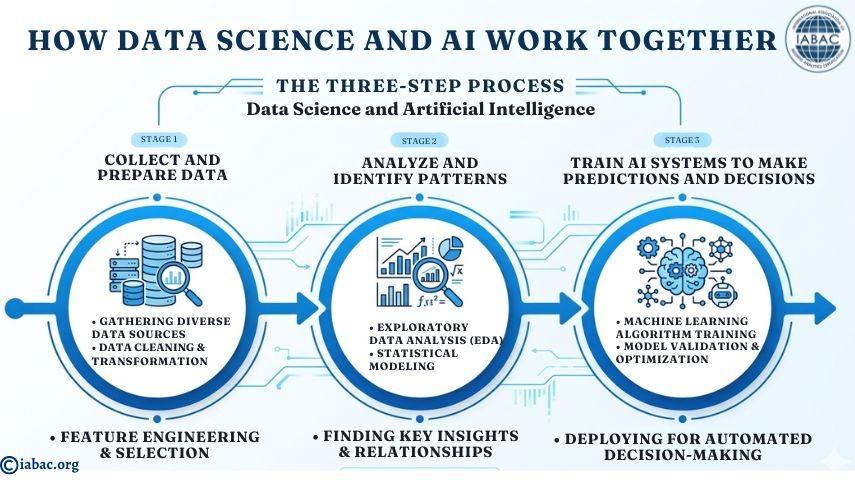
The relationship between Data Science and Artificial Intelligence can be understood as a three-step process:
- Collect and prepare data
- Analyze and identify patterns
- Train AI systems to make predictions and decisions
Imagine a hospital that wants to predict which patients are at greater risk of heart disease.
- Data scientists gather patient records and clean the information.
- They study patterns related to age, blood pressure, and medical history.
- AI models learn from these patterns and estimate future risk.
- Doctors use those predictions to provide earlier treatment.
The outcome is faster, more informed decision-making that can improve patient care.
A Simple Mathematical Example
Many AI models begin with straightforward formulas. One common example is linear regression.
genui{"math_block_widget_always_prefetch_v2":{"content":"y = mx + b"}}
In this equation:
- x represents an input, such as advertising spend.
- y represents the predicted result, such as sales.
- m indicates how strongly the input affects the result.
- b is the starting value.
Data scientists estimate these values using historical information, and AI systems use the equation to generate predictions automatically.
Industries Being Transformed
Healthcare
AI helps identify medical conditions from images and predicts patient outcomes. Data Science ensures the underlying data is accurate and meaningful.
Finance
Banks use AI to detect suspicious transactions and assess credit risk. Data Science supports model development and validation.
Retail
Companies analyze customer behavior and inventory trends to improve recommendations and reduce stock shortages.
Manufacturing
Sensors monitor equipment performance so AI can predict maintenance needs before breakdowns occur.
Education
Learning platforms adapt lessons based on student progress and performance patterns.
Global Demand for Talent
Demand for professionals with skills in Data Science and Artificial Intelligence continues to rise across the world.
Common roles include:
- Data Scientist
- Machine Learning Engineer
- AI Engineer
- Data Analyst
- Data Engineer
- Business Intelligence Analyst
These positions often offer strong compensation because they combine technical expertise with business impact.
Why Certifications Matter
A degree provides a foundation, but employers also look for practical, job-ready skills.
International Association of Business Analytics Certification offers globally recognized Data Science Certifications that cover topics such as:
- Python programming
- Statistics
- Machine Learning
- Data Visualization
- Model Evaluation
- Business Applications
The International Association of Business Analytics Certification Data Science Certification page (https://iabac.org/data-science-certification) provides detailed information for professionals seeking structured, industry-aligned learning paths.
The Typical Data Science Project Process
A data science project usually follows these steps:
- Define the problem
- Gather relevant data
- Clean and prepare the data
- Explore patterns and relationships
- Build predictive models
- Evaluate performance
- Deploy and monitor the solution
At first, cleaning data may seem surprisingly time-consuming. Many professionals joke that a large part of a project involves persuading messy spreadsheets to cooperate. Once the data is organized, building models becomes much easier.
Data Science and Artificial Intelligence in Daily Life
These technologies already affect everyday experiences:
- Streaming recommendations
- Voice assistants
- Navigation and traffic prediction
- Fraud alerts
- Personalized shopping suggestions
- Spam filtering
Because these tools operate quietly in the background, many people use AI-powered systems without realizing it.
Skills Needed in 2026
To build a successful career in artificial intelligence and data science, focus on:
- Mathematics and statistics
- Python or R
- SQL
- Machine Learning
- Data Visualization
- Communication and storytelling
- Business understanding
Strong communication is especially valuable. The best professionals not only build models but also explain what the results mean and why they matter.
Challenges and Responsibilities
As AI becomes more powerful, organizations must address:
- Data privacy
- Bias and fairness
- Transparency
- Security
- Ethical decision-making
Responsible use of data and models is essential for building trust.
Salary Trends for Data Science and Artificial Intelligence Professionals in 2026
One of the biggest reasons people are choosing Data Science and Artificial Intelligence as a career is the strong earning potential. Companies are willing to pay well because professionals in these roles help improve decisions, reduce costs, and create products that directly affect business growth.
Average Global Salary Ranges in 2026
| Job Role | Estimated Annual Salary (Global Range) |
| Data Analyst | $55,000 – $95,000 |
| Data Scientist | $90,000 – $180,000 |
| Machine Learning Engineer | $110,000 – $220,000 |
| AI Engineer | $120,000 – $250,000 |
| Data Engineer | $100,000 – $200,000 |
| Research Scientist | $140,000 – $300,000+ |
Why These Roles Command High Salaries
Organizations invest heavily in professionals who can:
- Predict customer behavior
- Detect fraud and security threats
- Automate repetitive work
- Improve healthcare outcomes
- Build recommendation systems
- Optimize supply chains
In simple terms, these professionals help companies save money and make smarter decisions. When a single model can reduce losses by millions of dollars, hiring skilled people becomes an easy business decision.
Which Is Better to Learn First: Data Science or Artificial Intelligence?
A common question is whether to start with Data Science or jump directly into AI.
My recommendation is to begin with Data Science.
Data Science teaches the fundamentals that every AI professional needs:
- Statistics and probability
- Python programming
- SQL
- Data cleaning
- Data visualization
- Machine Learning basics
Once you are comfortable with these topics, moving into Artificial Intelligence becomes much easier.
Trying to build AI systems without understanding data is like trying to bake a cake without checking whether you have flour. The recipe may look impressive, but the result will not be very satisfying.
A Practical Learning Roadmap for 2026
Step 1: Learn Programming
Start with Python, the most widely used language for data science and AI.
Step 2: Study Statistics and Mathematics
Focus on probability, linear algebra, and basic calculus.
Step 3: Practice SQL
Learn how to query and manage large datasets.
Step 4: Work on a Data Science Project
Build projects involving data cleaning, visualization, and predictive modeling.
Step 5: Learn Machine Learning
Understand regression, classification, clustering, and model evaluation.
Step 6: Explore Artificial Intelligence
Study neural networks, natural language processing, and computer vision.
Step 7: Earn Recognized Certifications
Programs from International Association of Business Analytics Certification can help validate your skills to employers worldwide.
Step 8: Build a Portfolio
Show your projects on platforms such as GitHub.
Step 9: Apply for Jobs
Target internships, freelance work, and entry-level roles.
Looking Ahead
In 2026, Data Science and Artificial Intelligence are among the most influential technologies shaping society and business. Data Science turns raw information into understanding. Artificial Intelligence uses that understanding to automate tasks and support better decisions. Together, they help organizations work more efficiently, reduce risk, and create new opportunities.
For anyone considering a future in technology, this is an excellent time to begin. Whether your goal is to become a Data Scientist, AI Engineer, or Machine Learning Specialist, the combination of practical skills and recognized credentials such as International Association of Business Analytics Certification certifications can provide a strong foundation. The future is being built with data. Those who know how to interpret it and apply it intelligently will play a central role in shaping what comes next.
Frequently Asked Questions
Is AI replacing Data Science?
No. AI and Data Science complement each other. Data Science prepares and analyzes data, while AI uses that data to make predictions and automate decisions.
Can beginners learn Data Science and Artificial Intelligence?
Yes. Many professionals start with no prior experience and build their skills step by step.
Do I need advanced mathematics?
A solid understanding of basic mathematics and statistics is sufficient to begin.
Are Data Science Certifications worth it?
Yes, especially when they are recognized internationally and focus on practical skills.
How long does it take to become job-ready?
With consistent practice, many learners can build a strong foundation within 6 to 12 months.

 English
 Arabic
 French
 Spanish
 Portuguese
 Deutsch
 Turkish
 Dutch
Dutch
 Russian
 Romaian
 Portuguese (Brazil)
 Greek
Greek