


Industrial automation relies on steady communication between controllers and field devices. For decades, RS485 has served as the primary physical layer for these connections. It is robust and supports long cable runs. However, the standard design follows a simple rule. It usually allows only one "Master" device to talk to multiple "Slave" devices.
Modern facilities now require more flexibility. Operators want to access data from multiple locations at once. They want a local touch panel and a remote cloud server to read the same sensor. This creates a "Multi-Master" environment. In these setups, two masters might try to talk at the exact same time. This leads to data collision.
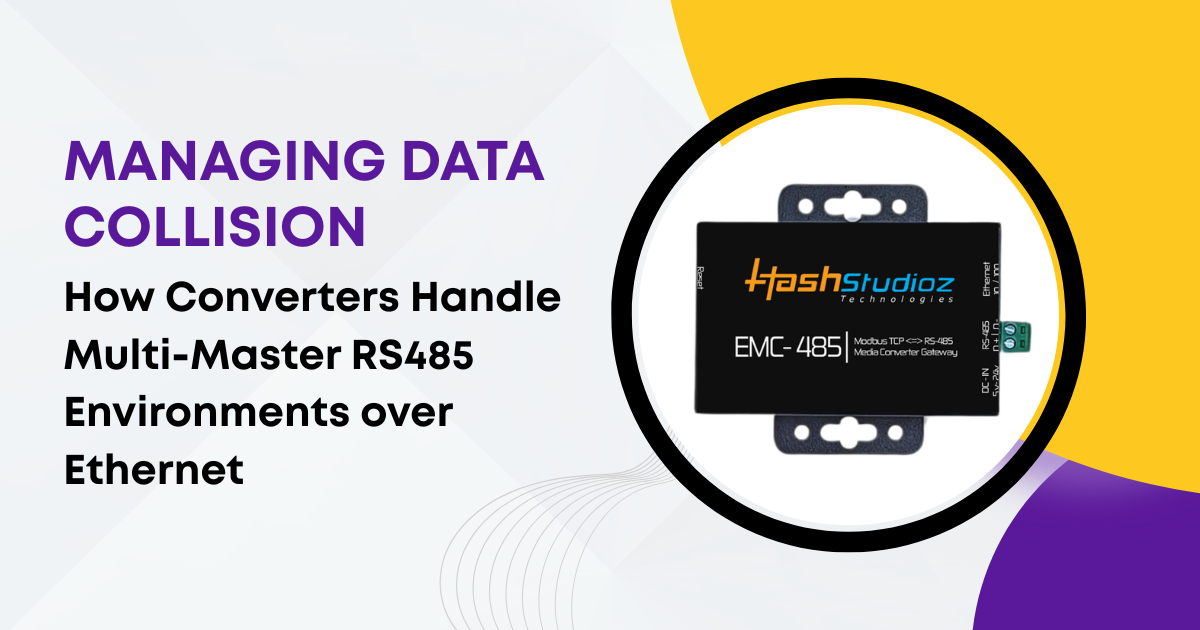
An RS485 to Ethernet Converter solves this problem. It bridges the serial wires to a local area network. This article explores how these devices manage collisions and maintain data integrity in complex networks.
Understanding the RS485 Physical Layer
RS485 uses differential signaling over a twisted pair of wires. This design rejects electrical noise very well. It supports up to 32 nodes on a single segment without repeaters.
The protocol is "Half-Duplex." This means devices can send or receive data, but not both at once. If two devices drive the voltage on the wires simultaneously, the signal becomes garbled. This is a collision. In a traditional Modbus RTU setup, the single Master prevents this. It asks a question and waits for an answer before asking the next one.
When you add an RS485 to Lan Converter, the rules change. The Ethernet side is much faster and follows different rules. Managing the timing between these two worlds is a major technical challenge.
What is an RS485 to Ethernet Converter?
This device is a specialized communication gateway. It features a serial port for RS485 wires and an RJ45 port for network cables. It converts serial data packets into TCP/IP or UDP packets.
Key Components of the Converter
-
Microprocessor: It handles the protocol conversion and timing logic.
-
Buffer Memory: It stores incoming data during busy periods.
-
Transceiver: It manages the physical voltage levels on the RS485 line.
-
Ethernet Controller: It manages the high-speed network interface.
By using an RS485 to Ethernet Converter, you remove the 1,200-meter distance limit of serial wires. You can monitor a machine in Tokyo from a desk in London.
The Challenge of Multi-Master Environments
A Multi-Master environment occurs when more than one device initiates a request. For example, a PLC and a SCADA system both want to read a power meter.
Why Collisions Happen
-
Overlapping Requests: Master A and Master B send commands at the same microsecond.
-
Slow Slave Responses: A slave takes too long to answer. Master B thinks the line is free and starts talking.
-
Network Latency: Ethernet packets arrive at the gateway at irregular intervals.
Without a smart RS485 to Lan Converter, these collisions destroy data packets. This causes "CRC Errors" or "Timeout Errors" in the control software.
How Converters Prevent Data Collisions
High-quality converters use specific technical methods to keep the traffic organized. They act as a traffic cop for the data.
1. Request Queuing (FIFO)
The converter treats incoming Ethernet requests like a line at a store. If three masters send a request, the converter puts them in a "First-In, First-Out" (FIFO) buffer. It sends the first request to the RS485 bus. It waits for the slave to answer. Only then does it send the second request.
2. Token Passing Logic
Some advanced systems use a virtual token. Only the device "holding the token" can use the serial bus. The RS485 to Ethernet Converter manages this token distribution among the connected IP addresses.
3. Master-Slave Arbitration
The converter can be programmed to prioritize certain masters. For example, a safety PLC might get priority over a data logging PC. The converter will pause the logger's request to let the PLC through first.
Technical Statistics on Signal Integrity
Data accuracy is the primary goal of any gateway. Industry tests show the impact of using smart converters versus simple "dumb" bridges.
| Setup Type | Collision Rate | Data Success Rate |
| Standard RS485 (Single Master) | < 0.1% | 99.9% |
| Multi-Master (No Gateway Logic) | 15% - 25% | 75% |
| Multi-Master (Smart Converter) | < 0.5% | 99.5% |
Studies show that latency increases slightly when using a queue. However, the reliability gain is worth the small delay. A 20ms delay is better than a lost packet that requires a 1,000ms timeout.
Protocol Conversion: Modbus RTU to Modbus TCP
Most RS485 devices use the Modbus RTU protocol. Most cloud systems use Modbus TCP. An RS485 to Lan Converter often performs "Modbus Gateway" functions.
The converter strips the CRC (Cyclic Redundancy Check) from the serial packet. It wraps the data in a Modbus TCP header. This header includes a "Unit ID" and a "Transaction Identifier." The Transaction ID helps the master match the answer to the correct question. This is vital when multiple masters are active. It ensures Master A does not receive the answer meant for Master B.
Hardware Features for Reliable Conversion
Not all hardware can handle the stress of a Multi-Master environment. You must choose devices with the right technical specs.
1. Isolation and Protection
Industrial floors have high-voltage equipment. This creates ground loops and surges. Look for a converter with 1.5kV or 2kV electromagnetic isolation. This prevents a surge on the serial line from frying your Ethernet switch.
2. High-Speed Buffers
The converter needs enough RAM to store multiple requests. If the buffer is too small, it will drop packets during peak traffic. A good RS485 to Ethernet Converter has at least 512KB of buffer memory.
3. Intelligent Timing (Silent Interval)
RS485 uses time gaps to define the end of a message. This is often 3.5 characters of silence. A smart gateway allows you to fine-tune this interval. This is critical for supporting non-standard or older serial devices.
Real-World Examples
1. Building Management Systems (BMS)
Modern office buildings use thousands of sensors for lights and air. These sensors often use RS485.
The building owner has a main control room. However, the maintenance team also has tablets to check the system. Both the control room and the tablets act as masters. By installing an RS485 to Lan Converter on each floor, both groups can see the data. The converter manages the requests so the lights turn on without delay.
2. Solar Power Plants
Solar farms use RS485 to monitor inverters. The local site controller needs this data for grid stability. At the same time, the corporate office wants the data for financial reports.
Using an RS485 to Ethernet Converter allows two different networks to pull data simultaneously. The local controller gets priority for safety. The corporate office gets the data a few milliseconds later. This prevents the inverter from getting confused by too many commands.
Benefits of Moving to IP-Based Serial
Switching to an Ethernet-based system provides many advantages beyond just collision management.
-
Scalability: You can add hundreds of converters to a single network.
-
Accessibility: You can use Wi-Fi or VPNs to reach your serial machines.
-
Cost Savings: You use existing office network cables instead of pulling new serial wires.
-
Diagnostic Tools: Most converters have web pages. These pages show real-time error counts and traffic logs.
Security Considerations for Converters
Connecting serial devices to a LAN opens them to cyber threats. RS485 has no built-in passwords.
1. IP Address Filtering
Configure the RS485 to Lan Converter to only accept traffic from specific IP addresses. This stops hackers on the network from sending commands to your machines.
2. Encryption (AES/TLS)
Some industrial gateways support encrypted serial tunnels. This is vital if the data travels over the public internet. It prevents "Man-in-the-Middle" attacks.
3. Password Protection
Always change the default password on the converter's configuration page. Many factory breaches happen because of "admin/admin" credentials.
Installation and Configuration Tips
To get the best performance, follow these technical steps during setup.
1. Set the Correct Baud Rate
All devices on the RS485 string must use the same speed. Common speeds are 9600 or 19200 bps. The RS485 to Ethernet Converter must match this speed exactly.
2. Termination Resistors
RS485 lines need 120-ohm resistors at each end of the cable. This prevents signal reflections. Reflections look like data to the converter and cause errors.
3. Use Shielded Cables
Always use shielded twisted pair (STP) cables. Connect the shield to a clean ground at only one point. This reduces the "noise" that causes the converter to work harder.
The Role of Virtual COM Ports
Many old Windows programs can only talk to "COM1" or "COM2." They do not understand IP addresses. Most RS485 to Ethernet Converter manufacturers provide driver software.
This software creates a "Virtual COM Port" on your PC. The program thinks it is talking to a local serial port. The driver takes the data and sends it over the network to the converter. This allows you to keep using old software while enjoying new network benefits.
Troubleshooting Collision Issues
If you see frequent errors, check these three areas.
-
Check the Timeout Settings: Increase the "Response Timeout" in your Master software. The gateway needs a few extra milliseconds to process the queue.
-
Monitor the Traffic LED: Most converters have "TX" and "RX" lights. If they are both on constantly, your bus is overloaded. You might need to split the devices onto two separate converters.
-
Inspect the Ground: A voltage difference between the gateway and the serial devices can cause fake data. This looks like a collision but is actually just electrical interference.
Future of Serial Connectivity
RS485 is not going away soon. It is too cheap and reliable to replace entirely. However, the gateways are getting smarter.
We now see "Edge Gateways" that run Linux. These can process the data before sending it to the cloud. They can even perform local logic. For example, the gateway can close a valve if the pressure is too high, even if the cloud is offline. The RS485 to Ethernet Converter is evolving from a simple bridge into a smart computer.
Conclusion
The transition from simple serial links to complex Ethernet networks is a major step for any facility. Managing data collisions is the most important part of this process. An RS485 to Ethernet Converter provides the necessary tools to keep data flowing.
By using queuing, arbitration, and protocol conversion, these devices ensure that every master gets the data it needs. They protect old equipment and make it ready for the modern digital world. Whether you call it an RS485 to Lan Converter or a serial server, the result is the same. You get a reliable, scalable, and professional network. Protect your industrial data by choosing the right conversion hardware today. Robust communication is the foundation of every successful automated system.

 Arabic
 French
 Spanish
 Portuguese
 Deutsch
 Turkish
 Dutch
Dutch
 Italiano
 Russian
 Romaian
 Portuguese (Brazil)
 Greek
Greek