


A brutally honest (and occasionally mortifying) look at why the classroom alone won't get you hired — and what actually will.
 Picture this: you spent months (maybe years) sitting through classes, scribbling notes about mean, median, and mode, maybe even surviving a statistics exam that felt like a near-death experience. You graduated. You updated your LinkedIn. You wore the expression of someone who had truly conquered the universe.
Then you walked into a job interview and the hiring manager asked, 'Are you a certified data scientist?' And somewhere inside, a tiny voice whispered: 'We didn't cover that.'
Welcome to 2025. The world of data science has changed more in the last three years than it did in the previous decade. The foundations of data science still matter — they will always matter — but relying on classroom theory alone is like showing up to a Formula 1 race in a bicycle. Technically still a vehicle. Practically not going to work.
'A certificate is not just a piece of paper. It is evidence that you did the work when no professor was watching.'
The Curriculum That Time Forgot
Let's be fair to academic institutions — they do a remarkable job of building foundational knowledge. The foundations of data science such as statistical inference, probability, linear algebra, and data wrangling are genuinely important. Nobody is arguing that.
The problem? Most traditional data science curricula were designed in a world before large language models, real-time ML pipelines, and cloud-native architectures became standard industry practice. In many cases, the textbooks being used today were written when Hadoop was still considered cutting-edge. Hadoop. Let that sink in.
The global data science and analytics market was valued at approximately $274 billion in 2023 and is expected to cross $650 billion by 2029 (Mordor Intelligence). The velocity of tools, frameworks, and methodologies in this field is extraordinary. A classroom operating on a three-year curriculum review cycle cannot keep pace with a field that reinvents itself every eighteen months.
This is not a criticism of education. It is a description of a gap — and that gap is where professional data science certifications step in.
What Employers Actually Look For (Hint: It's Not Just Your GPA)
A 2023 LinkedIn Workforce Report found that data science was among the top five most in-demand professional skills globally. However, employers increasingly distinguish between candidates who understand data science conceptually and those who can deploy, manage, and optimize real-world data solutions.
Think about what a machine learning expert actually does on a Tuesday afternoon. They are not re-reading a textbook chapter on gradient descent. They are versioning models, monitoring drift, integrating APIs, and answering angry Slack messages from the product team about why the recommendation engine thinks everyone wants to buy a kayak.
Employers want proof of applied skill. That proof comes in the form of recognized, globally validated best data science certifications — credentials that signal to any hiring manager, anywhere in the world, that you are not just familiar with data science, you are operational in it.
This is exactly the mission of IABAC (iabac.org) — the International Association of Business Analytics Certifications. IABAC exists to bridge precisely this gap between academic grounding and professional readiness, offering certifications that are recognized globally and structured around what the industry actually demands.
Data Science Is Everywhere — And 'Everywhere' Has Different Needs
One of the most persistent myths about data science is that it lives exclusively in tech companies. In reality, data science has colonized virtually every sector of the modern economy, and each sector requires a different flavor of expertise.
Finance: Where Data Science Meets Dollars
A data scientist in finance is not building movie recommendation engines. They are working on credit risk models, fraud detection systems, algorithmic trading frameworks, and regulatory compliance dashboards. The stakes are enormous — a poorly calibrated model in a financial institution can cost millions. Financial institutions actively seek professionals with credentials that demonstrate domain-specific competence in addition to technical skill.
Human Resources: Yes, HR Uses Data Science Too
The intersection of data science in HR is perhaps the most underestimated application in the entire field. Modern HR teams use predictive analytics for talent acquisition, employee attrition modeling, workforce planning, and performance optimization. If you think HR is just about performance reviews and birthday cakes, you have not seen what a well-deployed people analytics model can do. (Spoiler: it knows you're thinking about leaving before you do.)
Marketing: The Art Became a Science
The role of a data scientist in marketing has exploded in scope. Attribution modeling, customer lifetime value prediction, A/B testing at scale, sentiment analysis, and campaign optimization are now standard expectations. Marketing teams that operate without data science are essentially flying blindfolded — except the blindfold is made of assumptions and expired intuition.
Managers: Leading Without Understanding Is a Liability
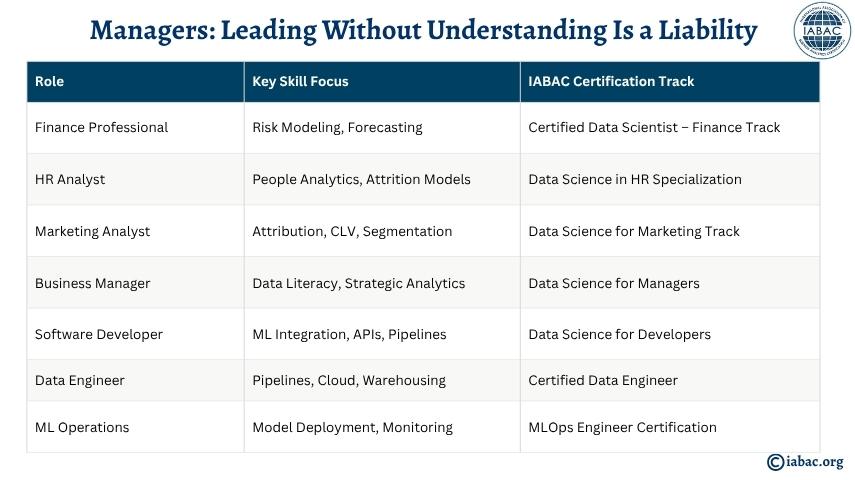
Perhaps the most important audience for data science for managers education is the one that least expects it: managers and business leaders. In a world where every strategic decision is informed by data, a manager who cannot interpret a confusion matrix or challenge a model's assumptions is at a significant disadvantage. They become dependent on whoever is presenting the data — which is a dangerous position to be in.
IABAC offers pathways specifically designed for business leaders who need to understand and direct data-driven operations without necessarily becoming engineers themselves.
The Developer Who Didn't Know What They Were Missing
Here is a scenario that plays out more often than anyone would like to admit. A talented software engineer — someone who builds elegant APIs, knows their design patterns, and could write a recursive function in their sleep — realizes their team has started building machine learning features into the product. Suddenly they are surrounded by conversations about feature engineering, cross-validation, and model serving that feel like a foreign language.
This is where data science for developers becomes not just useful, but career-critical. The gap between being a strong developer and being a developer who can contribute to ML-integrated products is bridgeable — but only with structured, recognized training. IABAC's certifications are specifically designed to meet developers where they are and bring them up to speed without forcing them to pretend they have never written a for-loop before.
'The certified data engineer is not the person who memorized the most SQL queries. They are the person who knows which data to move, when to move it, and how not to break everything in the process.'
MLOps: The Discipline Nobody Taught You But Everyone Now Needs
If you ask ten people what an MLOps engineer does, you will get eleven different answers, one of which involves the word 'DevOps' used incorrectly. MLOps — machine learning operations — is the discipline of deploying, monitoring, maintaining, and scaling machine learning models in production environments.
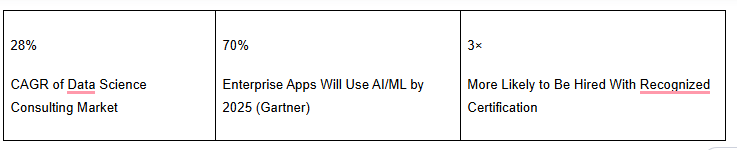
According to Gartner, by 2025, over 70% of new enterprise applications will incorporate AI and ML components. That means the demand for professionals who can manage the entire lifecycle of an ML model — from training to deprecation — is not a niche interest. It is a mainstream career track.
Traditional data science classes very rarely cover MLOps in any meaningful depth. They teach you to build the model. They do not teach you what happens when the model meets reality and reality fights back. An MLOps engineer certification from IABAC addresses this gap directly, covering CI/CD for ML, model monitoring, data drift, and infrastructure concerns that are invisible in a classroom but omnipresent in production.
Certifications Are Not a Shortcut. They Are a Proof of Work.
There is a misconception, sometimes whispered in academic corridors, that certifications are the 'easy way out' — that they are what people pursue when they could not complete a full degree. This is, to put it gently, spectacularly wrong.
A rigorous best data science certification requires you to demonstrate applied competence across multiple domains. You cannot memorize your way through a well-designed certification exam. You have to understand, apply, and synthesize.
IABAC's certification framework, recognized globally and aligned with industry competency frameworks, is not a participation trophy. It is a validated signal that you have met a professional standard. Employers across the globe — particularly in markets where credential verification matters enormously — recognize the IABAC designation as evidence of genuine capability.
The Consulting Angle: When Data Science Becomes a Service
Not every data scientist wants to work inside a corporation. A growing number of professionals are moving into data science consulting services — working independently or within boutique firms to help organizations that do not have in-house data science capacity.
The global data science consulting market is growing at approximately 28% CAGR, driven by the explosion of small and medium-sized enterprises realizing they need data capability but cannot afford a full-time team. For consultants, certification is not optional — it is their calling card. When a client is deciding between two consultants, the one with a recognized, globally validated credential from a body like IABAC has a measurable competitive advantage.
The IABAC Difference: Built for the Real World
IABAC (iabac.org) was not built to replicate what universities already do. It was built to do what universities structurally cannot: respond quickly to industry changes, offer role-specific credentials, and validate practical competency rather than just theoretical exposure.
The IABAC certification portfolio covers the full spectrum of the modern data profession. Whether you are a data scientist in finance looking for a credential that speaks the language of risk and compliance, an HR professional building people analytics capabilities, or a developer transitioning into ML engineering — there is a structured, globally recognized pathway for you.
- Certified Data Scientist (CDS) — The benchmark credential for practicing data scientists worldwide
- Certified Data Engineer (CDE) — For professionals building the infrastructure that data science runs on
- MLOps Engineer Certification — For those managing ML in production at scale
- Data Science for Managers — Strategic data literacy for business leaders
- Data Science for Developers — Bridging the gap between software engineering and ML
- Domain Specializations — Finance, HR, Marketing, and beyond
A Note to Those Who Are Waiting for the 'Right Time'
There is a particular type of professional paralysis that strikes people in fast-moving fields. It goes something like this: 'I'll get certified once I have more experience.' Or: 'I'll start once this project is done.' Or, the classic: 'I'm still deciding which certification is right for me' — as an excuse said while watching a television series for the fourth time.
The data is not kind to waiting. According to a 2024 Deloitte Insights report, professionals who pursue structured upskilling within the first two years of a career transition are 67% more likely to reach senior-level positions within five years compared to those who rely on on-the-job learning alone.
The best data science certification is not the one you are still researching in three years. It is the one you complete, validate, and put to work. IABAC makes that journey structured, achievable, and globally credible.
'In data science, standing still is technically moving backwards. The field does not pause for anyone to catch up.'
Classes Are the Beginning, Not the Destination
None of this is an argument against education. The foundations of data science taught in rigorous academic programs are genuinely valuable and should not be dismissed. But in a field that moves this fast, foundational knowledge is the floor, not the ceiling. The professionals who are thriving in data science today — the machine learning expert deploying production models, the certified data engineer building robust pipelines, the MLOps engineer ensuring models behave in the real world, the data scientist in marketing delivering measurable ROI — share one thing in common. They did not stop learning when the class ended.
They got certified. They stayed current. They made themselves undeniably hireable — and kept it that way.
If your current skill set is resting comfortably on what you learned a few years ago, consider this your friendly but firm nudge. The market is not waiting. The tools are not slowing down. And the gap between those who hold recognized, applied credentials and those who don't is only going to widen.
IABAC — iabac.org — exists to help you close that gap, wherever you are in the world, whatever sector you work in, and wherever you want to go next.
Your Certification Journey Starts Here
Explore globally recognized data science certifications built for real-world professionals. Finance. HR. Marketing. Engineering. Management. Whatever your domain, IABAC has a credential that speaks your language.


 English
 Arabic
 French
 Spanish
 Deutsch
 Turkish
 Dutch
Dutch
 Italiano
 Russian
 Romaian
 Portuguese (Brazil)
 Greek
Greek