


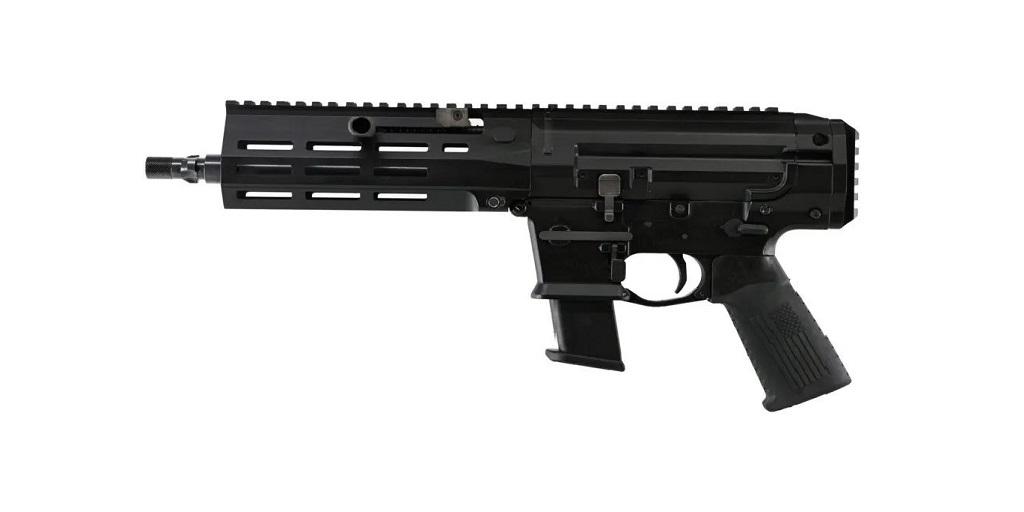
There are three main action types you can choose from if you want to build a PCC. These are direct blowback, gas impingement, and roller delayed blowback.
Gas impingement and roller delayed PCCs are more reliable than direct blowback models, and this short post will shed some light on the relative virtues of roller delayed blowback when compared to gas impingement.
Super Compactness
To operate, a gas impingement system needs a buffer system with weights to absorb some of the recoil as well as a recoil spring that returns the BCG to battery.
With a roller delayed PCC, you don't need the buffer system, and can remove the buffer tube entirely. This will enable a much more compact platform that will handle better in tighter spaces, and be easier to conceal.
When it comes to making a super compact PCC, roller delayed blowback, and even direct blowback operation, are superior to gas systems as you can forgo not just the buffer tube but the entire stock if you want.
Lighter Weight
Removing the buffer system from a PCC doesn’t just confer the benefit of a more compact build. It will also remove considerable weight from the platform.
Therefore roller delayed pistol caliber carbines can be much lighter than those with gas systems, which can result in less fatigue when shooting for prolonged periods of time.
Simpler Action Components, Fewer Opportunities for Failure or Malfunction
Overall, the action of a roller delayed firearm is simpler than a gas impingement system, despite its relative complexity when compared to direct blowback.
You may have heard that any instance of design complexity is an opportunity for failure. This is true. An obstructed gas tube or block, a malformed gas key on the bolt carrier group, or a fatigued recoil spring; all of these things can hamper or cripple a gas impingement action.
A roller delayed blowback action is simpler and as a result offers fewer opportunities for failures or malfunctions.
More Durable Action Components
It is also the case that roller delayed blowback actions are made with more durable action components that offer long service lifespans, potentially streamlining maintenance of the overall platform.
They’re Smooth Shooting and Work Well with Suppressors
Another big benefit of roller delayed PCCs is that they are inherently smooth shooting and perform very well with suppressors, with comparatively little port pop.
Not to suggest that a pistol-caliber carbine with a gas action couldn’t be tuned to shoot smoothly, but roller delayed actions are infamous for their silky operation.
Also, since they exhibit a greater degree of control over bore pressure, they perform well with suppressors, and since the action is so robust, suppressors won’t incur as much wear on them, comparatively.
Another note is that roller delayed PCCs are more shooter friendly with a suppressor, as you won’t get as much hot gas vented in your face when running a suppressed roller delayed platform.
For More Information on Roller Delayed PCCs
Don’t take this article the wrong way. Doubtless, there are many great direct blowback and gas impingement PCC builds in addition to roller delayed PCCs.
But it is also the case that roller delayed actions offer a considerable number of advantages. If you’re interested in learning about the definitive roller delayed PDW on the market, check out the MRDS PDW online at Zenith Firearms.
Light, compact, reliable, smooth shooting, and available in 9mm and 10mm, the MRDS PDW is a game-changer among roller delayed platforms. Visit the website listed for more information or get in touch with their customer service at Info@ZenithFirearms.com if you have any questions.
For more information about Mp5k Stock and Roller Delayed Blowback Please visit: Zenith Firearms.

 English
 Arabic
 French
 Portuguese
 Deutsch
 Turkish
 Dutch
Dutch
 Italiano
 Russian
 Romaian
 Portuguese (Brazil)
 Greek
Greek