


Understand how business analytics certification courses build job-ready skills, improve hiring chances, and help candidates stand out in competitive roles.
You’re scrolling through job listings, noticing how most roles ask for practical experience along with analytics skills. It feels frustrating when you understand the basics but aren’t sure how to prove your capability in real scenarios.
This is a common challenge many candidates face while trying to break into analytics roles. From an industry standpoint, employers prioritize individuals who can apply data insights to solve business problems.
Business analytics certification courses help bridge this gap by building practical skills, strengthening credibility, and aligning learning with real job expectations, making it easier to approach opportunities with clarity and confidence.
Building Job-Ready Skills That Match Industry Expectations
Employers consistently look for candidates who can contribute beyond basic knowledge. The ability to work with data, interpret results, and support decision-making plays a key role in hiring decisions across industries.
Key skills developed through certification courses:
-
Hands-on experience working with datasets used in real business scenarios
-
Strong understanding of data cleaning, processing, and interpretation techniques
-
Ability to convert analytical findings into actionable business insights
This kind of preparation ensures that learning directly connects with what organizations expect from day one, reducing the gap between training and job performance.
Turning Knowledge into Real Business Problem-Solving
Understanding tools and concepts is only one part of the journey. The real impact comes from applying that knowledge to solve practical business problems in a structured and meaningful way.
Certification programs are designed to simulate real-world situations where decision-making depends on data. Instead of focusing only on theory, they guide individuals through scenarios that require identifying patterns, evaluating outcomes, and suggesting solutions based on insights. This process gradually builds a problem-solving mindset that becomes valuable during interviews and on the job.
Strengthening Professional Credibility Through Certification
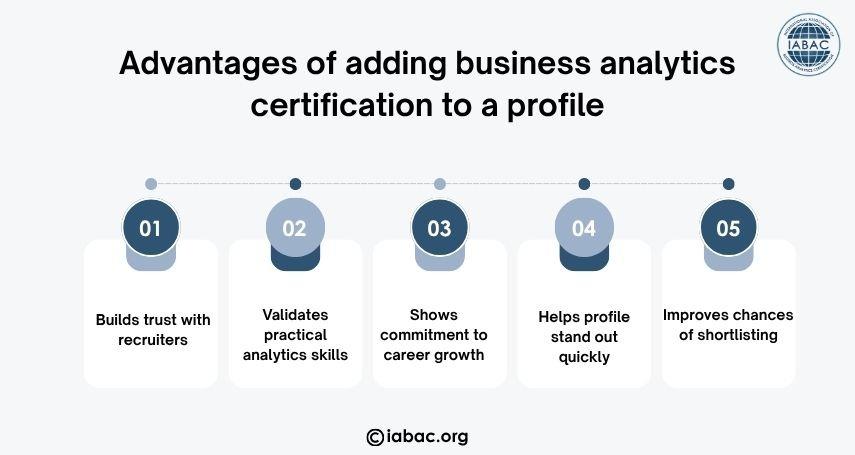
In a competitive job market, having relevant proof of skills can significantly influence hiring decisions. Certifications add a layer of credibility that reflects focused learning and commitment toward a specific career path.
Key advantages of adding certification to a profile:
-
Recognized credentials help build trust with recruiters and hiring managers
-
Demonstrates consistent effort toward developing industry-relevant skills
-
Creates a clear distinction from candidates with only academic qualifications
This added credibility often becomes a deciding factor when recruiters compare multiple candidates with similar educational backgrounds.
Gaining Practical Experience Through Projects and Assignments
One of the most valuable aspects of certification courses is the emphasis on practical learning. Instead of relying only on theoretical explanations, the focus remains on applying concepts through structured projects.
These projects are designed to reflect real business challenges, helping individuals understand how analytics is used in decision-making processes. Working on assignments regularly also improves confidence in handling tools and datasets independently, making it easier to adapt to real job environments.
Improving Communication and Business Understanding
Working with data is only effective when insights can be communicated clearly to stakeholders. Many candidates struggle at this stage because they focus heavily on technical aspects without understanding business context.
Key areas of improvement through certification:
-
Translating complex data findings into simple and meaningful insights
-
Structuring presentations that align with business objectives
-
Understanding how analytics supports decision-making across teams
This combination of technical and communication skills plays a crucial role in making candidates more effective and job-ready.
Aligning Skills with Industry Tools and Technologies
Modern organizations rely on specific tools and technologies to manage and analyze data efficiently. Certification courses ensure that learning is aligned with these industry standards, making candidates more relevant for job roles.
Exposure to tools such as Excel, SQL, Power BI, and Python helps build familiarity with real workflows used in organizations. Understanding how these tools fit into business processes also improves efficiency and adaptability, which are highly valued during hiring.
Increasing Confidence During Interviews and Assessments
Interviews often test not just knowledge but the ability to explain thought processes clearly. Confidence becomes a key factor, especially when candidates are required to solve problems or discuss case studies.
Certification courses prepare individuals for these situations by providing consistent practice and exposure to real-world questions. As familiarity with concepts and applications improves, it becomes easier to communicate ideas with clarity, making a strong impression during interviews.
Expanding Career Opportunities Across Multiple Industries
Business analytics is not limited to a single domain, which makes it one of the most flexible career options available. The skills developed through certification courses can be applied across different industries, increasing job opportunities.
Key industries where analytics skills are in demand:
-
Finance, healthcare, retail, and technology sectors continue to hiring actively
-
Marketing and e-commerce rely heavily on data-driven decision-making
-
Consulting roles require strong analytical and strategic thinking skills
This flexibility allows individuals to choose career paths based on their interests while still using the same core skillset.
Bridging the Gap Between Freshers and Job Requirements
A common challenge for freshers is the lack of practical experience expected by employers. Certification courses help address this issue by creating opportunities to work on real-world scenarios during the learning phase itself.
Through structured projects and assignments, individuals gain exposure to situations similar to actual job roles. This makes it easier to present themselves as capable candidates who understand professional expectations, even without prior work experience.
Creating a Strong Portfolio That Attracts Recruiters
A well-structured portfolio can significantly improve the chances of getting shortlisted for job opportunities. Certification courses guide individuals in building portfolios that reflect both technical skills and problem-solving ability.
Key elements that strengthen a portfolio:
-
Projects showcasing real-world business problem-solving capabilities
-
Use of multiple tools to demonstrate versatility in analytics work
-
Clear presentation of insights and outcomes in a structured format
A strong portfolio acts as proof of capability, making it easier for recruiters to assess skills beyond a resume.
Staying Aligned with Changing Industry Expectations
The field of business analytics continues to evolve with advancements in tools and technologies. Staying updated with these changes is essential to remain relevant in the job market.
Certification courses are regularly updated to reflect current industry practices, ensuring that learning remains aligned with hiring expectations. This helps individuals stay prepared not only for current roles but also for future opportunities.
Building a Clear and Structured Career Path
Starting a career without direction often leads to confusion and slow progress. Certification courses provide a structured path that helps individuals move step by step toward their goals.
With a clear roadmap covering fundamental concepts to advanced applications, it becomes easier to build skills gradually. This structured approach also helps in understanding different career options within business analytics, making decision-making more confident and informed.
Business analytics certification courses create a strong foundation for entering the job market with clarity and confidence. By combining practical learning, industry-relevant tools, and structured skill development, they make it easier to align with employer expectations and secure meaningful job opportunities. Get certified with IABAC Business Analytics and build practical skills that help secure the right job opportunities.

 English
 Arabic
 Spanish
 Portuguese
 Deutsch
 Turkish
 Dutch
Dutch
 Italiano
 Russian
 Romaian
 Portuguese (Brazil)
 Greek
Greek